



How to Prevent Unplanned Downtime Caused by Industrial Robot Cable Failures?
In high-stakes automation environments like automotive welding assembly lines and heavy industrial manufacturing, every second of production counts. Modern manufacturing facilities rely heavily on multi-axis industrial robots to maintain high throughput, precision, and consistency. However, a silent threat continually develops beneath the surface of these highly synchronized operations: industrial robot cable failure.
While structural components and robotic joints are engineered for millions of cycles, the internal cables and hoses running through the robot's upper arms—often referred to as the dress pack—are subjected to extreme, repetitive physical stress. When these cables fail unexpectedly, production grinds to a catastrophic halt.
To solve this, advanced factories are transitioning from reactive fixes to predictive maintenance using specialized components like the ABB Robotics CABLE IMS SENSOR ASSY (Part Number: 3HNA029012-001). This comprehensive guide explores why robot cables fail, calculates the true cost of unplanned downtime, and introduces a revolutionary shift toward data-driven cable health monitoring.
The Invisible Enemy: Why Robot Cables Fail in Heavy Industry
Industrial environments are notoriously harsh. To understand how to prevent cable failures, we must first analyze the unique mechanical and environmental stressors that target industrial robot cabling systems.
1. Multi-Axis Torsional and Bending Stress
Unlike static factory wiring, cables inside a 6-axis articulated robot arm are in perpetual motion. During high-speed operations, these cables endure simultaneous bending, pulling, and high-degree twisting (torsion). Over time, this constant mechanical fatigue causes copper strands inside the conductors to stretch, work-harden, and eventually snap. What makes this critical is that copper strands can break inside the insulation jacket without showing any external physical signs of wear.
2. High-Temperature Exposure and Thermal Cycling
In applications such as spot welding, arc welding, and foundry operations, cables are subjected to ambient heat radiation and intense thermal cycling. High temperatures accelerate the aging process of polymer insulation materials, making them brittle and prone to cracking. Once the outer protective jacket cracks, internal conductors lose their structural support and become highly vulnerable to immediate failure.
3. Weld Spatter and Environmental Contamination
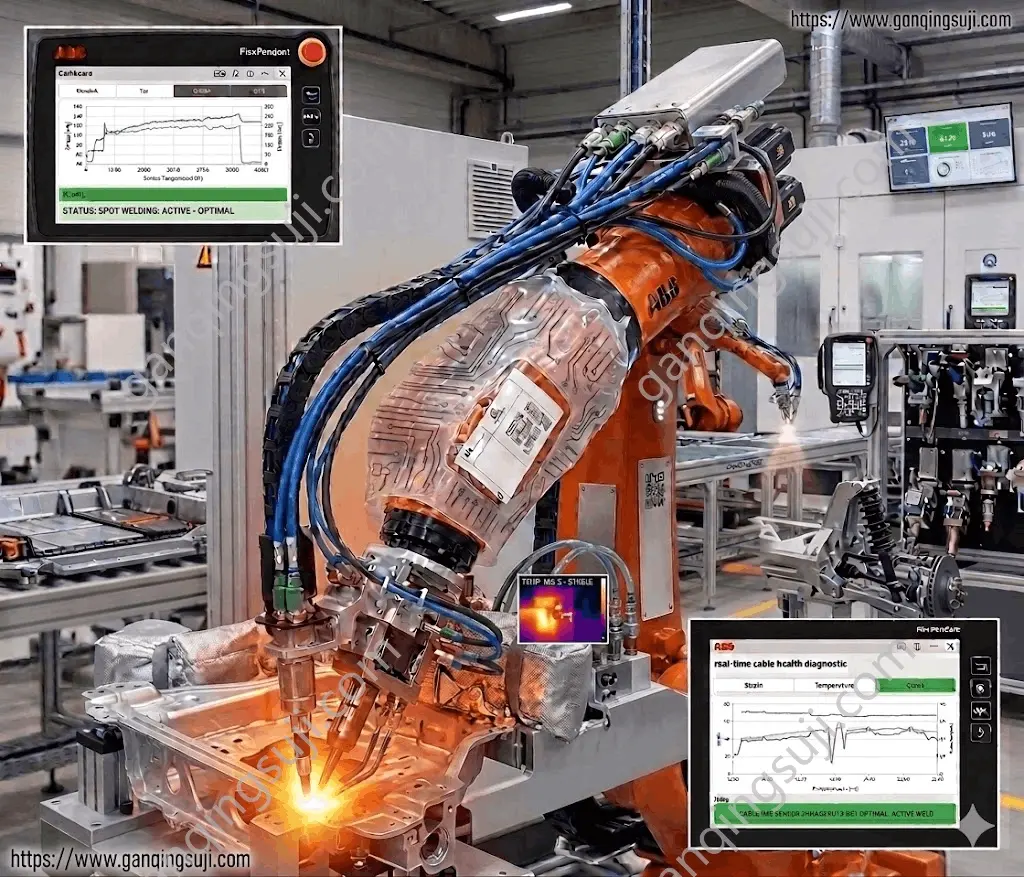
Automotive spot welding environments expose dress packs to a constant barrage of hot weld spatter, flying sparks, and ambient industrial oils. Slag and spatter can burn through basic protective sleeves, fusing cables together or melting them directly to the robot arm. This restricts the natural movement of the cable bundle, creating acute stress concentration points that dramatically shorten cable lifespan.
The Staggering Cost of Unplanned Downtime
For plant managers and production directors, cable failure is not just a technical inconvenience—it is a major financial disaster.
Cable Wear/Stress➡️ Hidden Strand Breaks➡️ Sudden Signal Loss ➡️ Line Stoppage
In high-volume automotive manufacturing, the cost of an unplanned production line stoppage can easily range from $20,000 to $50,000 per minute. If a critical welding robot's control or power cable breaks during a shift, the compounding losses include:
● Direct Revenue Loss: Unproduced vehicles or components directly reduce daily output targets.
● Scrapped Workpieces: Sudden emergency stops often ruin the specific parts currently being processed or welded, leading to material waste.
● Labor Idle Time: Hundreds of operators and line workers stand idle while maintenance teams scramble to locate the failure.
● Expedited Repair Costs: Rushing emergency replacement parts and flying in specialized technicians incurs massive premiums.
Relying on traditional reactive maintenance (waiting for the cable to snap before fixing it) or generic preventative maintenance (blindly replacing expensive cables every 6 months regardless of actual condition) leaves your facility exposed to massive unplanned downtime costs that are no longer economically viable.
The Solution: Predictive Maintenance with the ABB CABLE IMS SENSOR
To completely eliminate sudden production stoppages, forward-thinking factories are adopting predictive maintenance technologies. Instead of guessing when a cable will fail, advanced monitoring systems allow the cable to communicate its own health status in real-time.
This is where the ABB Robotics CABLE IMS SENSOR ASSY 3HNA029012-001 transforms factory floor operations. By embedding smart sensor technology directly into the robotic cable architecture, the system continuously analyzes internal structural integrity.
Real-Time Strain & Temperature Monitoring
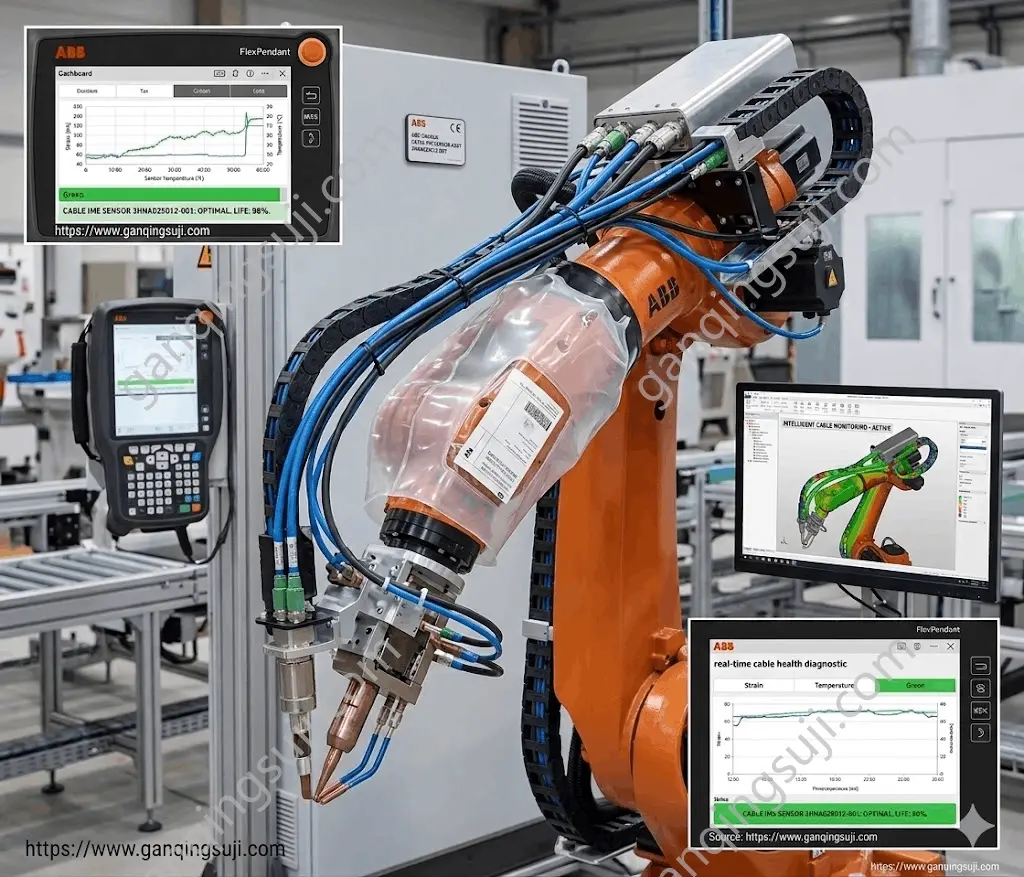
The ABB 3HNA029012-001 sensor operates on a dual-axis diagnostic matrix:
1. Strain Monitoring: It measures the microscopic mechanical tension, compression, and torsional force acting on the internal core conductors. If a cable is routed incorrectly or twisting beyond its design limits, the strain index spikes immediately.
2. Temperature Monitoring: It tracks internal thermal accumulation caused by both ambient environmental heat and internal electrical resistance changes.
By cross-referencing real-time Strain and Temperature data, the system detects microstructural changes inside the cable long before an actual electrical open-circuit or short-circuit occurs.
Seamless FlexPendant Integration
All diagnostic data from the "3HNA029012-001"sensor is fed directly into the native ABB human-machine interface. Operators and maintenance personnel do not need external computers or complex software. To fully leverage these insights, teams can learn [how to optimize industrial robotics performance with a brand new ABB DSQC 679 teach pendant 3HAC028357-001 (https://www.ganqingsuji.com/knowledge/how-to-optimize-industrial-robotics-performance-with-a-brand-new-abb-dsqc-679-teach-pendant-3hac028357-001) to effectively monitor the visual health dashboard showing a precise percentage of remaining optimal life (e.g., "OPTIMAL LIFE: 98%").
When the cable approaches the end of its reliable operational life, the system triggers a clear warning. This gives maintenance teams days or weeks of advance notice to schedule a replacement during a planned weekend maintenance window, completely bypassing costly mid-shift emergency stoppages.
Implementing a Zero-Downtime Strategy
Transitioning your facility to a predictive, zero-downtime model involves three simple steps:
Step 1: Audit High-Risk Robotic Cells
Identify the specific robots in your plant that perform the most complex, high-speed, or high-temperature movements—particularly automotive spot welding units and heavy material handling systems.
Step 2: Retrofit with Intelligent Cable Monitoring
Deploy specialized monitoring cables, such as the genuine ABB Robotics CABLE IMS SENSOR ASSY. These units easily integrate into existing setups, providing instant monitoring capabilities without modifying core robot programming.
Step 3: Act on Predictive Insights
Train your maintenance crew to monitor the FlexPendant health percentages during daily check-ins. Set automated threshold alerts so that any cable dropping below an optimal health index automatically triggers a low-priority maintenance work order.
By tracking actual wear rather than relying on estimated timeframes, you maximize the service life of every single cable asset while ensuring your production line never suffers an unexpected interruption.
Why Source Your ABB 3HNA029012-001 from Trusted Suppliers?
When dealing with high-precision predictive maintenance components, component authenticity is non-negotiable. Installing a counterfeit or substandard sensor cable can lead to false readings, either failing to warn you of an impending break or triggering false alarms that halt production unnecessarily.
Sourcing your ABB Robotics CABLE IMS SENSOR ASSY 3HNA029012-001 from verified industrial automation suppliers ensures:
● Factory-Level Calibration: Microscopic strain gauges are calibrated precisely to match ABB's factory specifications.
● Plug-and-Play Compatibility: Instant recognition by the ABB FlexPendant diagnostic software upon connection.
● Durable Industrial Build: High-grade polymer jackets designed to withstand the exact torsional stresses and temperature spikes found in automotive welding cells.
Protect your bottom line, eliminate unpredicted failures, and elevate your facility's operational efficiency by upgrading your high-stress robotic dress packs with intelligent, real-time diagnostic sensors today.
Email:Sales01@ganqingsuji.com