



How to Achieve Precise Blade Control in Tobacco Cutting?
In high-speed industrial manufacturing, timing is not just a performance metric—it is the baseline of product viability. This reality is nowhere more apparent than in secondary tobacco processing. Modern cigarette making and packing lines operate at astronomical speeds, often producing up to 20,000 cigarettes per minute. At these speeds, a microsecond deviation in mechanical execution results in massive product waste, inconsistent densities, and costly unscheduled downtime.
At the center of this demanding operational environment is the primary processing cutter. Achieving consistent slice widths, clean cuts, and uncompromised leaf integrity requires exact synchronization between raw material feeding and blade execution. This comprehensive guide explores the core challenges of tobacco cutting control systems and details how implementing advanced automation solutions—such as the AMK KWD 2 Servo Drive—allows factory floor managers to unlock unprecedented levels of accuracy and throughput.
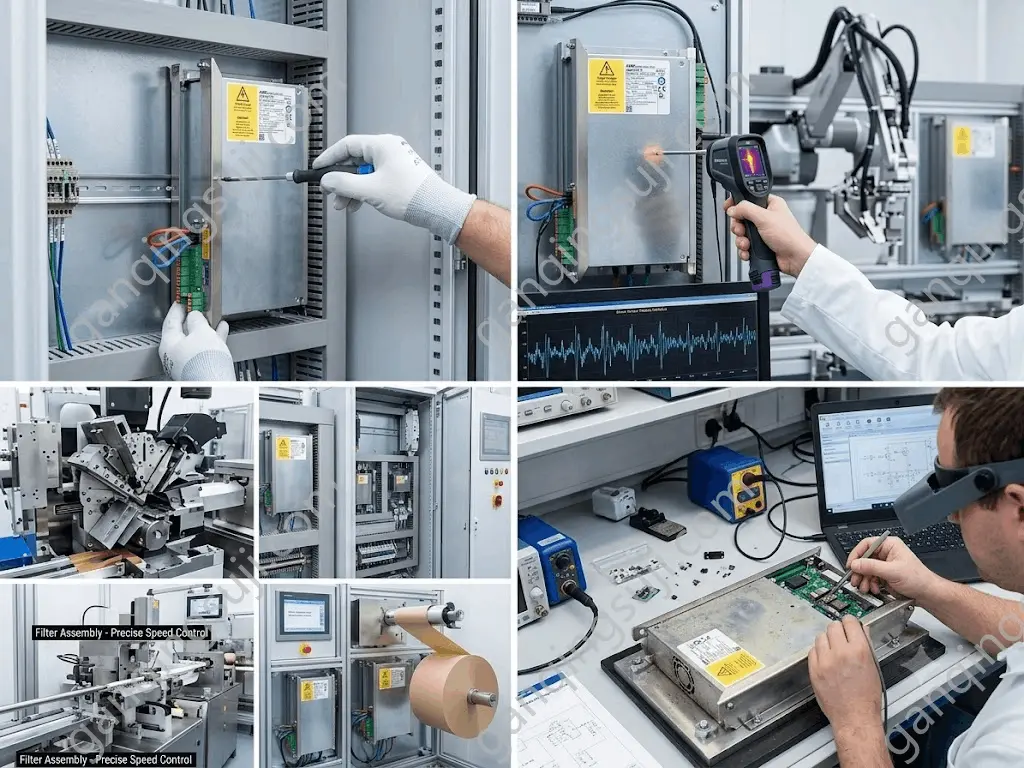
The Critical Role of Precision in Modern Tobacco Cutting
Tobacco leaf cutting is a highly sensitive physical process. Unlike uniform synthetic materials, processed tobacco leaves exhibit natural variations in moisture content, elasticity, and density. When the cutting knife strikes the dense compressed tobacco cake, the mechanical system experiences rapid, non-linear load fluctuations.
If the drive powering the cutting knife cannot react dynamically to these changing forces, several systemic failures occur:
● Inconsistent Cut Widths: Minor fluctuations in blade speed vary the thickness of the shredded tobacco strands (rag). This alters the burning characteristics and taste profile of the final product.
● Increased Dust and Fines Generation: A dragging or improperly timed blade crushes the leaf rather than slicing it cleanly. This creates excess tobacco dust, leading to material waste and clogged machinery.
● Rapid Blade Wear: Micro-stalls and speed overshoots put immense thermal and mechanical stress on the cutting edge, severely shortening knife lifespans.
To mitigate these issues, primary processing equipment relies on dynamic motion control profiles. The cutting blade must not only maintain a rigid velocity profile but must also adjust its positioning in real-time based on the incoming product feed rate.
Deconstructing the Technical Challenges of Blade Positioning
To understand how to solve the problem of blade deviation, we must first look at the control loop limitations of legacy hardware. Traditional systems frequently decoupled the conveyor drive from the cutting head control loop. This architecture created a dangerous propagation delay. By the time a downstream sensor detected a minor slip in the wrapper feed or leaf cake conveyor, the blade had already completed several off-center cutting cycles.
True optimization requires tight electronic camming (e-cam) synchronization. The cutting axis must act as a precise slave to the master virtual encoder tracking the material advance. This demands an industrial drive capable of executing high-frequency current, velocity, and position control loops simultaneously.
Furthermore, tobacco processing environments are notoriously harsh. Fine tobacco dust acts as an abrasive and insulator, settling into electrical cabinets and mechanical assemblies. Hardware chosen for this application must feature both robust physical sealing and exceptional thermal management properties to prevent premature component failure during continuous 24/7 production runs.
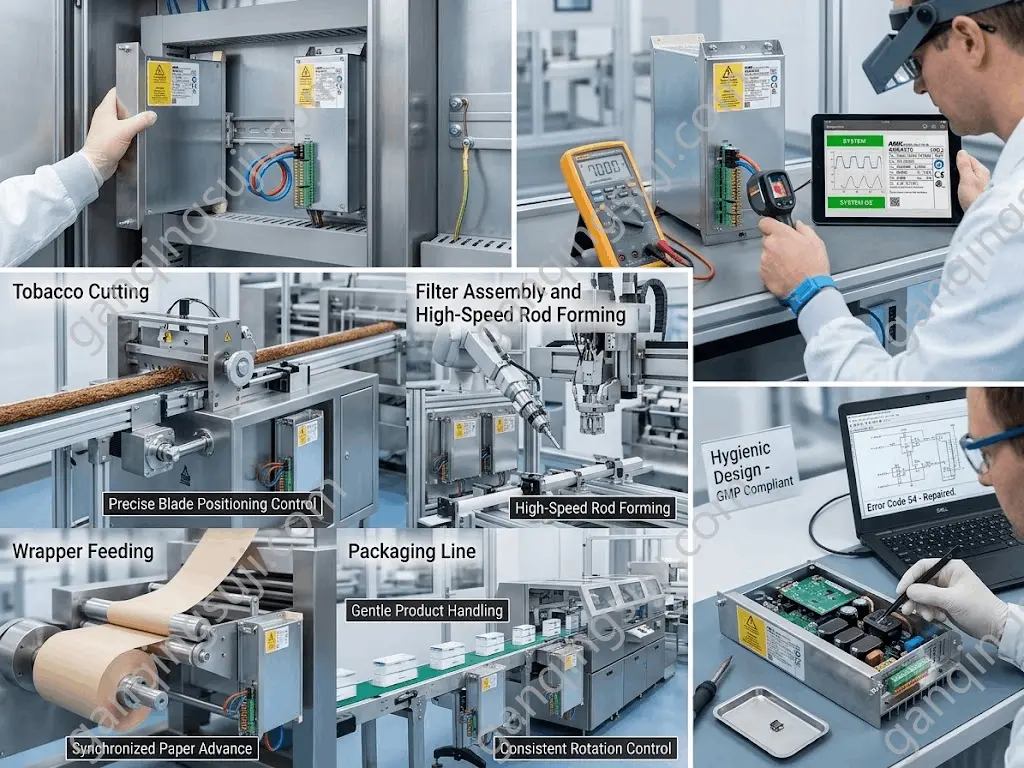
Solving the Precision Equation with Advanced Servo Architecture
Overcoming these structural boundaries requires moving past generic variable frequency drives into the domain of high-performance servo technology. The AMK KWD 2 Servo Drive (specifically identified by the Ordering Number: E760) is specifically engineered to handle these intense multi-axis synchronization demands.
Real-Time Microsecond Synchronization
The KWD 2 series utilizes high-bandwidth communication protocols to drastically compress control cycle times. When executing complex electronic gearing motions, the drive monitors encoder feedback directly from the blade shaft. If a density spike in the tobacco cake attempts to slow the blade down, the drive instantly injects corrective peak torque. This rapid adjustment ensures the blade maintains its absolute positional relationship to the material feed down to the micrometer.
Dynamic Electronic Camming for Multi-Stage Lines
In comprehensive cigarette production setups, tobacco cutting does not happen in isolation. The cutting system must seamlessly communicate with downstream processes. By leveraging the advanced processing capabilities of the KWD 2 drive, engineers can seamlessly link the primary cutting sequence with the secondary High-Speed Rod Forming phase. This integrated approach ensures that as shredded tobacco shifts into continuous rod production, the density data transfers down the line, adjusting feed rates and compacting tools dynamically without pausing the line.
Thermal Resilience and Maintenance Diagnostics
The physical environment of a primary tobacco processing plant demands hardware that can withstand extreme conditions. The compact footprint and advanced thermal dissipation architecture of the KWD 2 ensure stable operation even when mounted in densely packed control cabinets.
Additionally, by integrating modern predictive maintenance strategies, the drive continuously monitors structural parameters like torque ripple and winding temperatures. Any unexpected deviation acts as an early warning indicator. Technicians can use portable diagnostic equipment, such as thermal imaging cameras, to identify mechanical resistance or blade dulling before it triggers a critical system shutdown.
Synergistic Automation Across the Whole Production Line
While tobacco cutting precision remains the focal point for maximizing raw material yields, a factory cannot reach peak efficiency by optimizing a single machine. The true power of modern motion control is realized when the identical high-performance drive platform is deployed across every major axis of the manufacturing line.
For example, downstream from the primary cutter, the wrapper feed system must manage delicate papers or tipping materials. Utilizing the exact same KWD 2 servo platform for wrapper feeding guarantees a perfectly synchronized paper advance. This eliminates tension spikes that cause paper tearing.
Similarly, the drive's fast input processing capabilities make it ideal for integration into quality inspection zones, triggering instant defect rejection mechanisms without compromising overall system velocity. When the entire production floor utilizes a standardized, high-performance automation layer, cross-talk communication lag drops to zero, and spare parts management becomes vastly simplified.
To see how these individual control blocks assemble into a cohesive, high-output industrial ecosystem, you can explore our comprehensive breakdown of modern Tobacco Machinery Automation configurations.
Implementing Best Practices for Servo Configuration
Upgrading to high-end drive hardware is only the first step; maximizing your return on investment requires adhering to strict implementation standards during commissioning.
1. Optimize the Velocity Loop Tuning: Given the erratic load characteristics of tobacco cake, standard PI (Proportional-Integral) tuning loops often result in excessive overshoot. Engineers should implement aggressive feed-forward gains based on acceleration profiles to allow the drive to preemptively counter mechanical resistance.
2. Ensure Rigid Mechanical Coupling: Any backlash in the gearbox or coupling assembly will negate the microsecond response times of the servo drive. High-torque, zero-backlash planetary gearboxes are mandatory for high-speed cutting applications.
3. Shield Sensitive Feedback Lines: The high-frequency switching frequencies of high-performance drives can introduce electromagnetic interference (EMI) into encoder feedback cables. Always route feedback lines through dedicated, grounded conduits away from high-power supply cables.
For engineering teams looking to benchmark their current machine performance against international industry baselines, the Open-Source Automation Council provides highly detailed technical frameworks covering open communication architectures and multi-axis safety profiles via their official OMAC Packaging Workgroup portal.
The Long-Term Business Impact of Precision Control
Investing in premium motion control solutions yields measurable dividends across your entire operational balance sheet. By transitioning your cutting systems to a high-precision, low-latency drive ecosystem, your facility will unlock immediate structural advantages:
● Reduced Material Scrap Rates: Eliminating cut deviations directly translates into tons of saved raw tobacco material over a typical annual production cycle.
● Lower Total Cost of Ownership (TCO): Smoother torque transitions protect gearboxes, bearings, and knives from harsh mechanical shocks, driving down routine component replacement expenses.
● Enhanced Brand Consistency: Delivering uniform, perfectly shredded tobacco ensures your final consumer products meet exact weight and density regulations, preserving brand reputation globally.
To learn more about the evolving regulatory landscape governing high-speed consumer goods production equipment, consult the comprehensive standards compiled by the International Organization for Standardization (ISO), which outlines key safety and efficiency metrics for automated industrial machinery.
Conclusion
Achieving flawless tobacco cutting precision is no longer a luxury reserved for custom specialty machines. By pairing a deep understanding of mechanical leaf dynamics with cutting-edge drive architecture like the AMK KWD 2, modern manufacturing facilities can eliminate the production bottlenecks of the past. Standardizing your high-speed processing loops on robust, responsive, and intelligent drive systems is the fastest path to securing your competitive edge in a demanding global market.