



How Does ABB Sealed Hollow Wrist Improve Paint Booth Efficiency?
In modern industrial manufacturing, the paint booth is both a critical stage for product quality and a notorious bottleneck for maintenance. Automated painting lines rely heavily on robotic arms to achieve a flawless, consistent finish. However, the harsh environments of spray painting—filled with volatile organic compounds (VOCs), paint mists, and constant high-speed wrist rotation—pose a severe threat to robotic components. Cable failure, fluid leakage, and paint contamination are constant risks that trigger unexpected downtime.
To overcome these challenges, automotive and industrial coating facilities are increasingly turning to advanced robotic hardware. The ABB 3HNA027421-001 represents a significant leap forward in this field. By integrating a specialized robotic hollow wrist module manufacturers can radically optimize their coating processes. But how exactly does this sealed hollow wrist design transform paint booth efficiency? Let’s dive into the technical details and operational benefits.
The Costly Challenges of Traditional Cable Routing in Paint Booths
Before evaluating the benefits of a robotic hollow wrist module, it is essential to understand the vulnerabilities of traditional external cable dressing. In standard articulated robots, the hoses that deliver paint, solvent, and compressed air, along with electrical control cables, are strapped to the outside of the robot's arm and wrist.
This external setup creates three major operational headaches in a paint booth environment:
● Mechanical Wear and Tear: As the robot moves through complex paths to coat intricate parts, external cables are subjected to continuous twisting, bending, and whipping. Over time, this mechanical stress leads to friction, shielding degradation, and eventual cable breakage.
● Paint Mist Accumulation: Automated painting generates a fine airborne mist. This sticky overspray accumulates rapidly on external cables. As the paint cures, the cables stiffen, losing their flexibility and accelerating mechanical failure.
● Contamination and Quality Defects: Cured paint on external hoses can crack and flake off due to the robot’s rapid movements. If these microscopic paint flakes fall onto a freshly coated surface, they create surface defects (such as craters or blemishes), forcing costly re-work.
When a cable breaks or causes a quality defect, the entire production line grinds to a halt. In high-volume automotive manufacturing, a single hour of downtime can cost tens of thousands of dollars. Therefore, protecting the industrial robot cable routing system is paramount.
1. Eliminating Cable Friction via Internal Routing
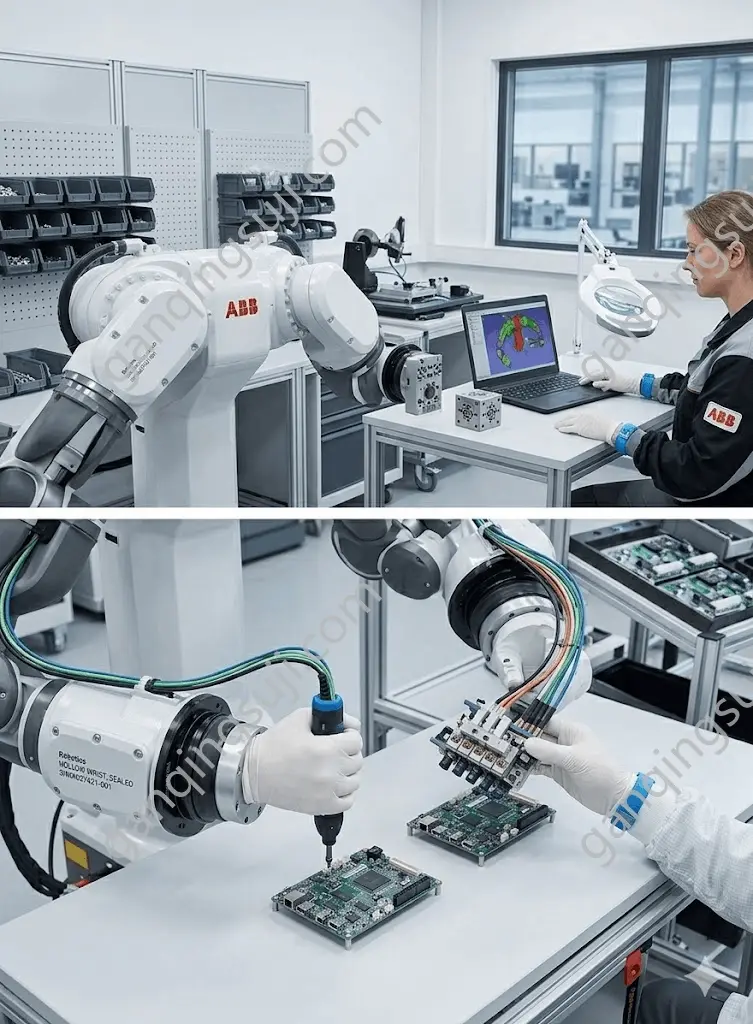
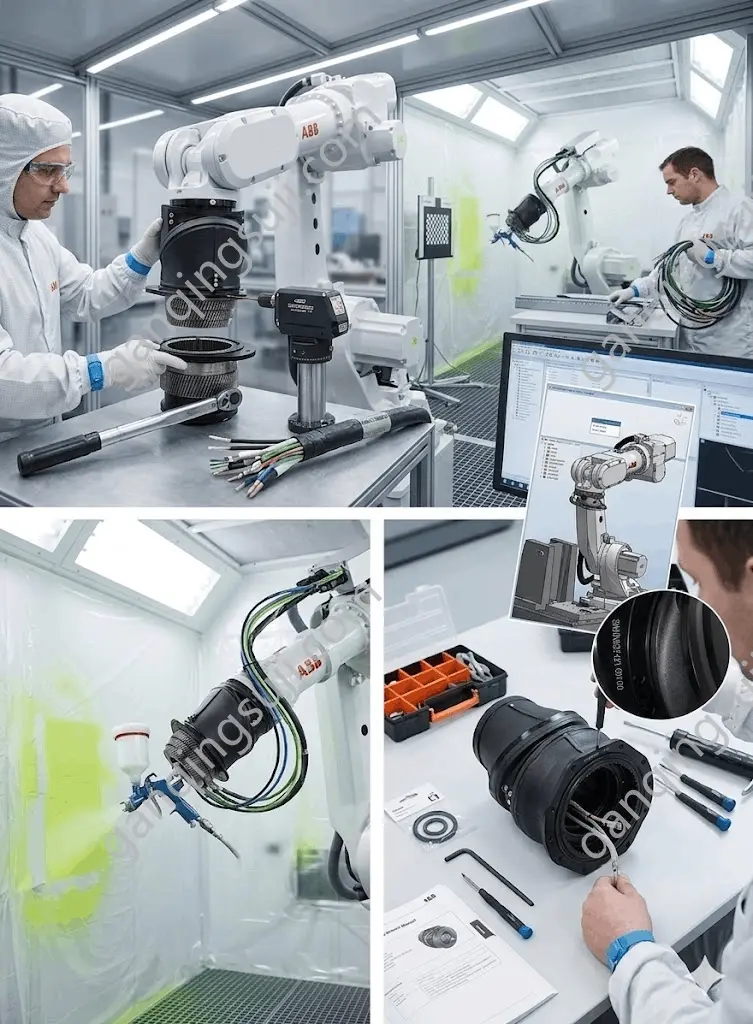
The primary innovation of the ABB 3HNA027421-001 is its hollow core design. Instead of routing critical fluid lines and electrical cables along the exterior of the robotic arm, this module allows all lines to pass directly through the center of the wrist axis.
This shift from external to internal industrial robot cable routing delivers immediate efficiency gains:
Zero External Whipping
Because the cables are contained within the hollow center, they rotate on their own axis rather than whipping around the robot arm. This completely eliminates the risk of cables catching on booth fixtures, paint overlapping gear, or the product itself.
Reduced Torsional Stress
The internal management system naturally controls the bend radius of the hoses. It distributes torsional stress evenly across the length of the cable rather than concentrating it at a single bend point, drastically extending the service life of internal components.
Compact Maneuverability
Without a bulky external cable bundle ("dress pack"), the robot gains a much slimmer profile. It can easily maneuver inside tight spaces, such as automotive interiors, engine bays, or complex geometric structures, without restricting its range of motion.
2. Advanced Sealed Protection Against Harsh Chemicals
A hollow wrist alone is not enough for a paint booth; it must be completely isolated from the environment. The ABB 3HNA027421-001 features an advanced, heavy-duty sealed construction specifically engineered to withstand the demanding conditions of industrial coating.
Paint booths are chemically aggressive environments. Automated systems frequently flush lines with corrosive solvents, thinners, and water-borne or solvent-borne paints. Additionally, the booth may undergo high-pressure cleaning cycles.
The robust seals of this ABB module prevent any ingress of these hazardous substances into the delicate internal mechanical gears and electrical connections. By keeping paint mist and solvents out, the wrist maintains its factory-grade lubrication and prevents internal corrosion. This specialized sealing technology satisfies the strict hygiene and explosion-proof safety requirements typical of modern automated coating cells.
3. Maximizing Paint Transfer Efficiency and Quality
Paint booth efficiency is not just measured by uptime; it is also heavily dependent on material yield and surface finish quality. The ABB 3HNA027421-001 directly influences these metrics by enabling a cleaner, more direct path for fluid delivery.
When paint lines run through a sealed, optimized hollow wrist, the distance between the fluid control valves and the spray gun nozzle is minimized. This short, stable path provides several distinct advantages:
● Precise Fluid Regulation: Shorter hose runs mean less pressure drop and faster response times when triggering the spray gun. This allows for precise control over the paint flow rate, leading to uniform film thickness and reduced overspray.
● Faster Color Changes: In manufacturing lines that handle multiple colors, lines must be flushed with solvent before switching colors. Internal, optimized routing reduces the volume of paint trapped in the lines, resulting in faster color-change cycles and less wasted paint and solvent.
Contamination-Free Environment: Since there are no external moving hoses to collect overspray or shed dried paint flakes, the ambient air inside the booth stays cleaner. This directly correlates to a lower defect rate and a higher first-run capability.
4. Simplifying ABB Robotics Maintenance Scheduling
In any high-capacity factory, maintenance is inevitable. However, there is a massive difference between scheduled, predictive maintenance and emergency, reactive maintenance. The design of the ABB 3HNA027421-001 helps shift plant operations toward a highly predictable schedule.
Traditional external cable packs require frequent visual inspections and alignment adjustments, often on a weekly or even daily basis. Conversely, a sealed internal system shields the cables from the environment, allowing maintenance teams to align their inspection intervals with standard ABB robotics maintenance cycles.
Conclusion: Driving ROI in Automated Coating
Maximizing efficiency in a robotic paint booth requires a combination of smart software, quality coatings, and exceptionally durable hardware. Investing in a premium component like the ABB 3HNA027421-001 sealed hollow wrist is a proven strategy for reducing total cost of ownership (TCO).
By moving to an internal, sealed routing system, you eliminate the leading causes of paint booth downtime: cable wear, overspray contamination, and fluid delivery fluctuations. The result is a highly reliable robotic system that delivers flawless surface finishes, faster cycle times, and minimal maintenance overhead. For any facility looking to boost throughput and secure a competitive edge in automated coating, upgrading to a high-performance robotic hollow wrist module is a necessity.