



Why Is ABB 3HAC14279-1 Essential for Multi-Robot Coordination?
In the highly competitive landscape of modern manufacturing, plant efficiency is no longer defined by how fast a single machine can run. Instead, it is governed by orchestration—how seamlessly different automated systems communicate, share physical spaces, and collaborate in real time. As factories push the boundaries of spatial optimization, single-robot work cells are rapidly being replaced by dense, multi-robot environments. At the center of this technological shift is a piece of hardware that acts as the grand conductor of the factory floor: the ABB main computer board, specifically identified by part number 3HAC14279-1.
For automation engineers, production managers, and procurement specialists, understanding the direct relationship between hardware computing thresholds and multi-axis synchronicity is vital. When multiple industrial robots operate within the same physical envelope, even a microsecond of signal latency can result in severe mechanical collisions, ruined workpieces, or catastrophic operational downtime. This comprehensive guide explores why this specific CPU board remains an absolute bottleneck for multi-robot performance, how it solves synchronization challenges, and how to optimize your hardware lifecycle to maintain peak manufacturing output.
1. The Multi-Arm Synchronization Challenge in Modern Factories
To appreciate the engineering significance of the ABB controller hardware, one must first look at the sheer mathematical complexity of multi-robot cells. In applications like heavy automotive chassis welding or large-scale aerospace material handling, two or more robotic arms must work in perfect harmony. In a typical master-slave configuration, one robot might manipulate a complex, heavy component while a secondary arm simultaneously tracks the moving workpiece to apply precision welds or chemical sealants.
For this operation to succeed, the control network must solve two overlapping computational challenges simultaneously:
● Geometric Path Interpolation: The control system must dynamically calculate the inverse kinematics of twelve or more independent mechanical joints in real time, ensuring that the relative velocity between the two robot tools remains exactly zero.
● Spatial Collision Avoidance: The system must actively monitor the physical boundaries of each arm, calculating predictive deceleration curves to prevent the structural links from colliding during high-speed maneuvers.
Executing these highly complex calculations requires more than standard industrial computing power. It demands a dedicated architecture optimized for deterministic processing, where data transfer speeds between the main processing core and the individual servo drive modules are tightly controlled and completely immune to external electrical interference.
2. Technical Anatomy: Why the 3HAC14279-1 Empowers Coordinated Motion
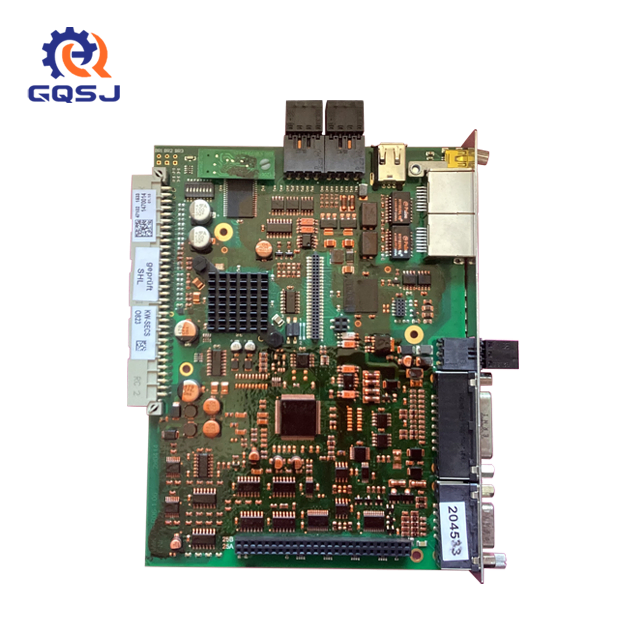
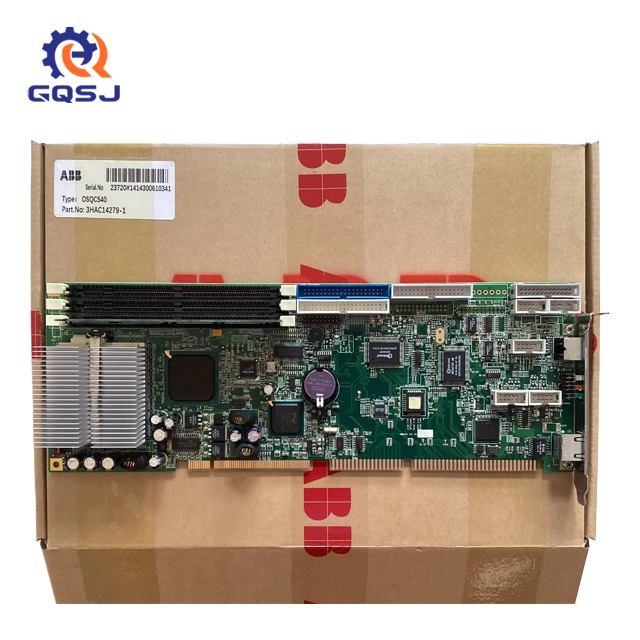
The ABB DSQC540 processing unit achieves its remarkable coordination capabilities through a specialized hardware topology designed specifically to eliminate data communication bottlenecks within modern robot control systems.
High-Bus Bandwidth and Real-Time Clock Synchronization
At the core of multi-robot synchronization is clock jitter—the tiny variations in timing signals as they travel across a circuit board. If the clock signal driving Robot A arrives even three milliseconds later than the signal driving Robot B, their physical trajectories will drift, resulting in deformed weld seams or assembly misalignment. The board features an optimized bus architecture that enforces strict determinism, ensuring that synchronization commands are dispatched across the entire robot cell simultaneously.
Integrated Kinematic Processing Cores
Calculating the trajectories for a single six-axis robot involves solving complex non-linear geometric equations multiple times per millisecond. When you multiply that by three or four robots working inside a single coordinated cell, the mathematical overhead scales exponentially. The board contains dedicated mathematical processing blocks that offload these spatial kinematic calculations from the main application software, allowing the controller to maintain a steady, high-frequency control loop under maximum operational load.
This robust processing infrastructure allows the system to sustain exceptional levels of precise motion control, allowing factories to achieve micron-level repeatability even when multiple mechanical units are executing aggressive, high-speed interlocking maneuvers on the same assembly line.
3. Real-World Applications: Welding, Assembly, and Logistics
The true value of this advanced computing hardware is realized in the high-stakes environments of real-world manufacturing plants, where it powers distinct automated applications.
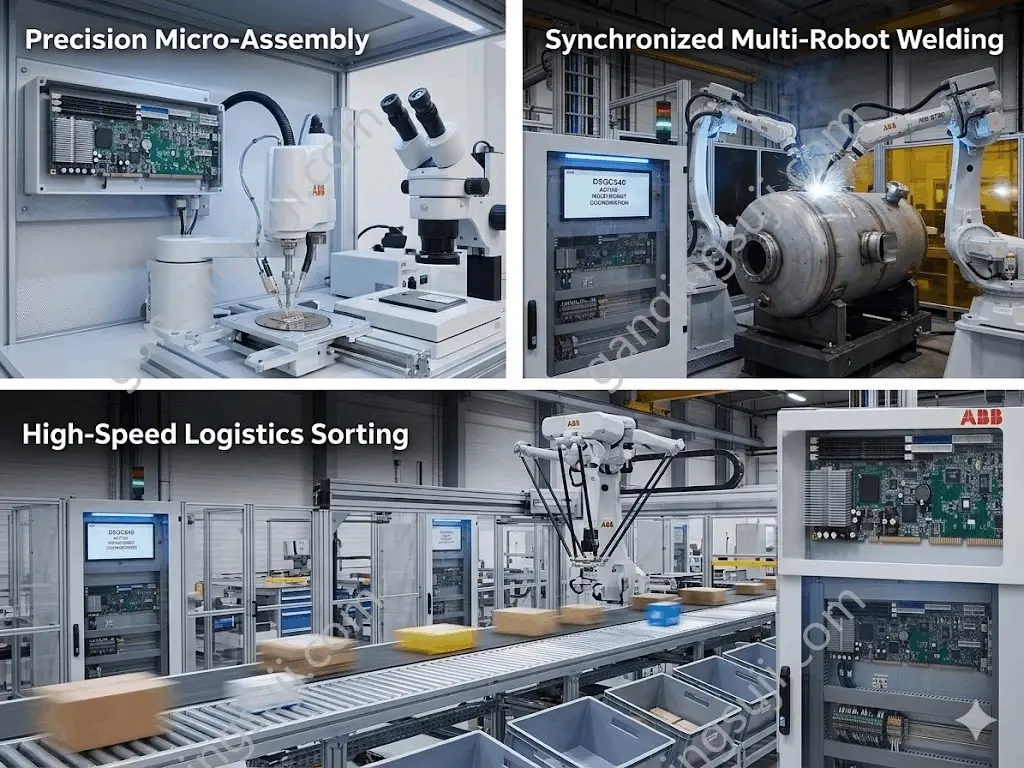
Synchronized Multi-Robot Welding
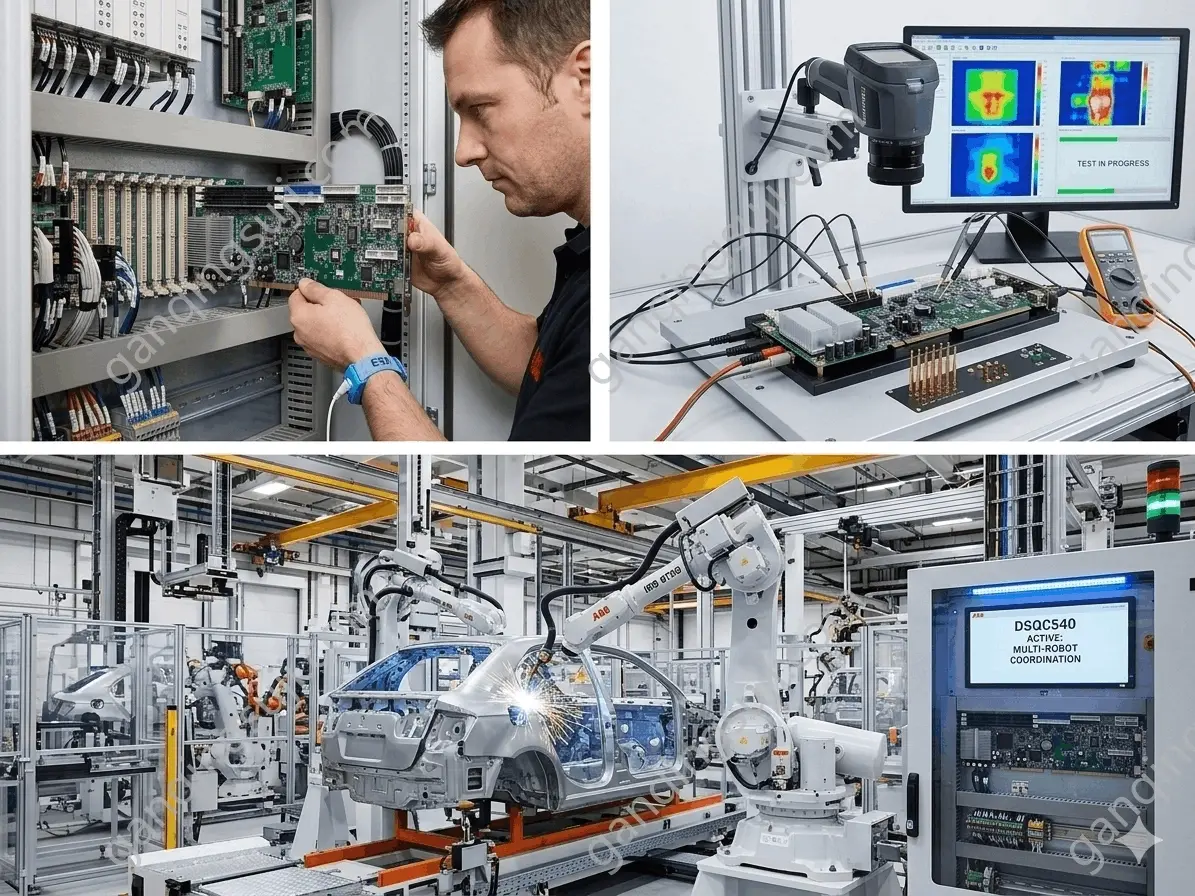
In automotive body shops, efficiency is driven by how many spot or arc welds can be applied within a 60-second cycle. Rather than moving a vehicle chassis sequentially through separate single-robot stations, modern lines use the processor to coordinate three or four welding arms working on a single chassis at the same time. The board dynamically manages the shared workspace, allowing the arms to weave past one another with inches of clearance, maximizing weld density while cutting cycle times in half.
High-Speed Logistics Sorting
In distribution and packaging centers, parallel-link Delta robots are frequently deployed over fast-moving conveyor systems to sort randomly oriented packages. The central processor ingests data from high-speed overhead vision systems and encoder inputs from the conveyor, distributing picking tasks among the robots. By managing the cell as a single coordinated system, it prevents multiple robots from targeting the same package, ensuring seamless, non-collision material sorting at maximum velocity.
4. Preventative Maintenance and Mitigating Multi-Robot Downtime
Because the main CPU board acts as the central brain for the entire multi-arm cell, its operational health directly dictates the uptime of your entire production facility. In a single-robot setup, a hardware failure stops one process. In a coordinated multi-robot cell, a failure on the main processor instantly paralyzes the entire multi-arm array, resulting in costly immediate idle time for downstream operations.
Industrial control enclosures are tough environments for delicate electronics. Over time, factors like ambient heat accumulation, fine airborne dust, and subtle power grid fluctuations degrade sensitive logic gates and capacitors. To combat this, smart factories employ proactive diagnostic routines:
● Thermal Imaging Profiles: Technicians utilize infrared cameras during live production cycles to scan the surface of the controller boards. By monitoring the thermal signature of the board, maintenance teams can identify abnormal hot spots in processing chips or voltage regulators, allowing them to schedule a replacement before an unexpected breakdown occurs.
● Firmware Lifecycle Alignment: When managing complex automated cells, keeping your system software synchronized with original hardware specifications is essential. Sourcing genuine, exact-match replacement hardware ensures full compliance with legacy fieldbus networks and specialized automation protocols.
To learn more about international technical compliance, safety profiles, and architecture definitions for advanced manufacturing, engineers should refer to the technical libraries provided by global organizations and leading developers of modern robotics controllers, ensuring all system field upgrades align with recognized global safety and performance standards.
Conclusion: Securing the Brain of Your Automation Infrastructure
As industrial automation trends toward higher densities and faster cycle times, the importance of robust, high-performance control hardware will only continue to grow. The ABB 3HAC14279-1 CPU board is not merely a spare component; it is the fundamental technological enabler for complex multi-robot coordination, trajectory planning, and high-speed synchronized manufacturing.
By maintaining verified, high-quality controller components and utilizing modern preventative diagnostic tools, plant operators can effectively eliminate the risk of unexpected hardware failure. Investing in original, high-spec processing units ensures that your robotic cells continue to operate as a perfectly synchronized, highly efficient ecosystem—protecting your factory's bottom line and keeping your production lines moving forward seamlessly.