



Why Does AMK DT 4 Overheat in Tobacco Machinery?
In the tobacco manufacturing industry, precision and speed are non-negotiable. Whether it is a high-speed cigarette making machine or a complex packaging line, every component must operate seamlessly. Among these, the AMK DT 4 Servo Motor plays a critical role in driving positioning and actuating tasks. However, maintenance technicians frequently face a common operational challenge: motor overheating.
Understanding why these convection-cooled motors overheat in tobacco production environments is essential for both procurement managers and repair engineers. This guide explores the root causes of thermal issues and provides actionable troubleshooting steps to maximize your equipment's uptime.
1. The Tobacco Production Environment: A Dual Challenge
Tobacco manufacturing plants present a unique set of operating conditions that can severely impact industrial automation components. Two main factors contribute directly to motor overheating:
● High Dust Accumulation: The processing of tobacco leaves generates significant amounts of fine organic dust. This dust settles on every available surface, including the cooling fins and housings of nearby motors.
● High-Speed, Continuous Operations: Modern tobacco packaging machinery and cigarette making equipment run at extreme speeds to meet high production quotas. This continuous or high-frequency intermittent duty cycle naturally generates substantial internal heat.
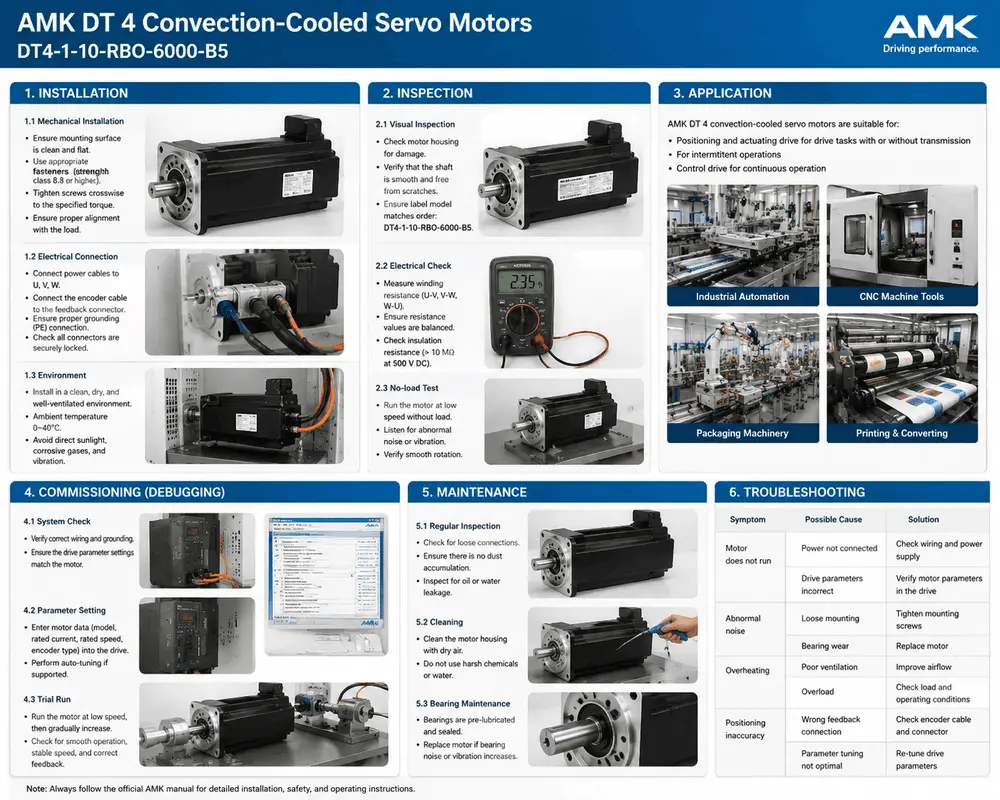
Unlike fan-cooled alternatives, convection-cooled motors rely entirely on natural air convection to dissipate heat. When the surrounding environment compromises this mechanism, thermal stress increases rapidly.
2. Root Causes of AMK DT 4 Overheating
When an AMK Automation motor begins to experience high temperatures, it is rarely due to a single isolated event. Instead, it is usually a combination of environmental factors and parameter mismatches.
Poor Ventilation and Dust Blanketing
The primary cause of overheating in tobacco factories is a lack of airflow. According to official technical specifications, these motors must be installed in clean, well-ventilated environments. When a thick layer of tobacco dust covers the motor housing, it acts as an insulator. The heat generated by the internal stator cannot escape, causing the internal temperature to spike.
Mechanical Overload and Binding
Tobacco dust can also penetrate mechanical seals over time, mixing with lubricants and creating a sticky residue. This increases friction within the bearings or the connected transmission gearboxes. To overcome this resistance, the servo motor draws more current than its rated capacity, leading to rapid heat buildup.
Parameter Misalignment
If the drive parameter settings do not perfectly match the specific motor model (such as the DT4-1-10-RBO-6000-B5), the drive may supply incorrect current or voltage frequencies. Sub-optimal parameter tuning forces the motor to operate inefficiently, transforming electrical energy into waste heat rather than mechanical torque.
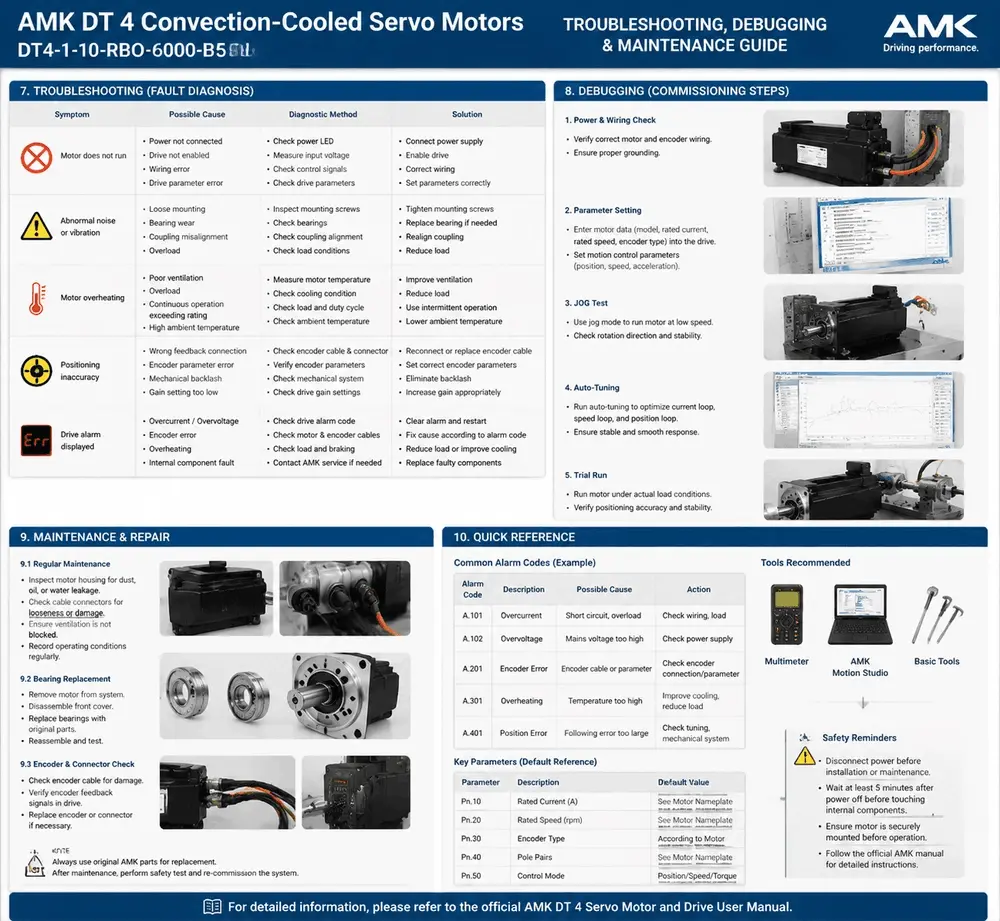
3. Diagnosing Technical Faults: From A.301 to A.401
When the internal temperature sensors detect critical thermal levels, the system triggers protective protocols. For technicians performing servo motor troubleshooting, identifying the exact alarm code is the quickest path to resolution.
● Alarm Code A.301 (Overheating): This code directly indicates that the temperature has exceeded safe thresholds. The immediate response should be to check the load conditions and improve local cooling.
Alarm Code A.401 (Position Error): While primarily a positioning issue, chronic overheating can degrade encoder signal feedback accuracy. If the encoder cable or internal components get too hot, tracking errors occur, causing unexpected line stops.
4. Maintenance Best Practices for Tobacco Engineers
Preventing thermal failure requires a proactive approach to daily and weekly maintenance routines.
Implement a Strict Cleaning Schedule
Never allow dust to accumulate on the motor chassis. Clean the motor housing regularly using dry compressed air. Avoid using water or harsh chemical solvents, as these can damage the specialized synthetic encapsulation of the rotor designed to resist dust infiltration.
Check and Realign Mechanical Couplings
Ensure that the motor shaft is smooth, free from scratches, and perfectly aligned with the driving load. Misalignment creates axial and radial forces that overload the bearings, causing both abnormal noise and excessive heat.
Verify Drive Parameters and Electrical Balance
Regularly measure the winding resistance across the U-V, V-W, and W-U phases to ensure balanced values. Additionally, check the drive control parameters within your motion control studio to confirm that current limits and positioning loops are optimized for intermittent tobacco packaging cycles.
Conclusion
Overheating in AMK DT 4 servo motors within the tobacco sector is a manageable challenge. By understanding the combined impact of fine tobacco dust and high duty cycles, maintenance teams can intervene before a thermal shutdown occurs. Regular cleaning, precise mechanical alignment, and accurate drive parameter tuning are the keys to ensuring long-term operational reliability and high-speed production efficiency.