



How to Troubleshoot AMK DT7 Servo Motor Errors Easily?
Industrial automation relies heavily on precision, and any unexpected downtime can cause massive production bottlenecks. The AMK DT7 series, particularly the highly efficient AMK DT7-17-20-EOO-3500-B5 servo motor is a robust solution widely trusted for high-dynamic and continuous operations. Thanks to their specialized design, these convection-cooled servo motors deliver exceptional performance without the need for external cooling fans. However, like any precision industrial component, they can encounter operational hitches over time due to wear, electrical fluctuations, or environmental stress.
If your machinery has ground to a halt or is exhibiting erratic behavior, you do not need to panic. Diagnosing and resolving these errors does not always require calling in external support immediately. By following a structured approach, you can manage industrial diagnostics efficiently right on the factory floor. Whether this specialized motor is driving heavy automation lines or working as a heart component in customized heavy-duty industrial ventilation setups, maintaining a steady supply of high-grade range hood accessories and motor replacements is crucial for preventing costly operational delays. This comprehensive guide will walk you through the exact steps needed to identify root causes and implement reliable solutions for your AMK DT7 motor.
Section 1: Initial Inspections and Installation Checks
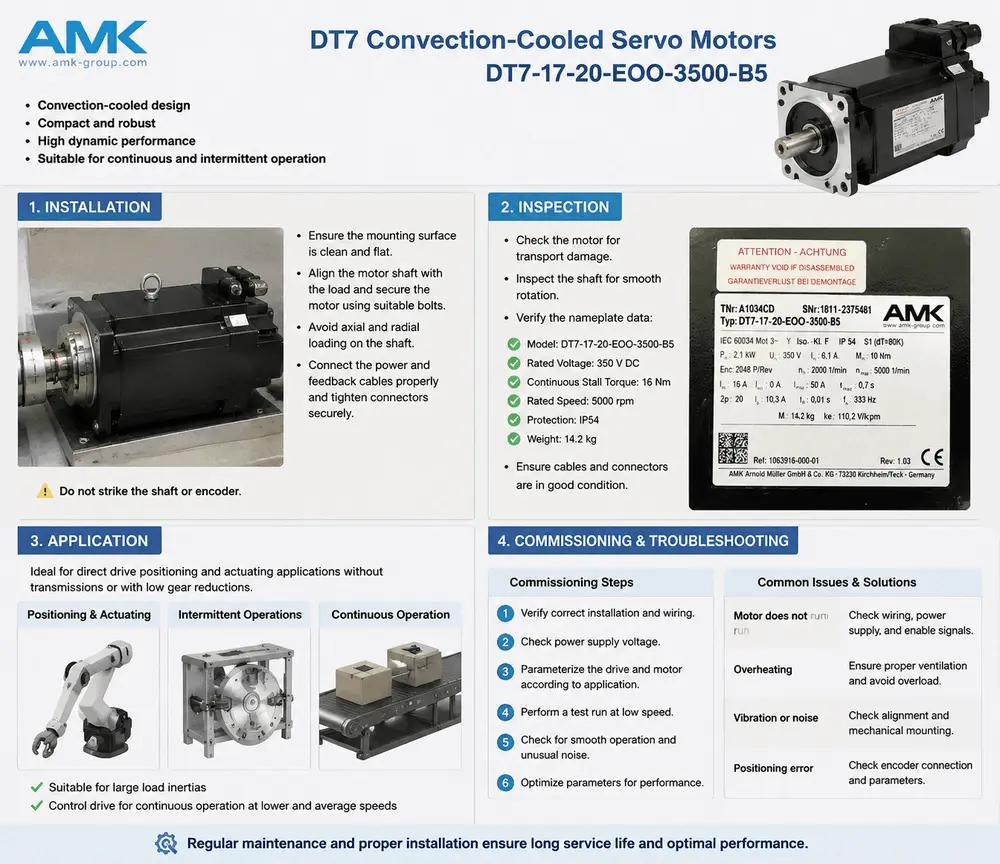
Before diving into complex electrical diagnostics, it is critical to eliminate basic mechanical and installation flaws. A significant percentage of servo motor failures stem from incorrect mounting or loose physical connections.
First, inspect the mounting surface. It must be perfectly clean and flat. Any minor unevenness can introduce structural stress to the motor housing during operation, leading to premature shaft misalignment. When aligning the motor shaft with the external load, secure the unit using the exact bolt specifications recommended by AMK. Misalignment is a silent killer of high-performance motors; it introduces unwanted axial and radial loading on the internal bearings, causing rapid mechanical degradation.
Equally important is the cable integrity. Ensure that both power cables and feedback system connections are tightly fastened and free of physical damage or kinks. Loose connectors can introduce intermittent signals, which confuse the drive controller and throw fatal error codes.
Remember a golden rule of maintenance: Never strike the motor shaft or the optical encoder with a hammer or heavy tool during installation, as this causes irreversible internal damage.
Section 2: Comprehensive Troubleshooting Matrix
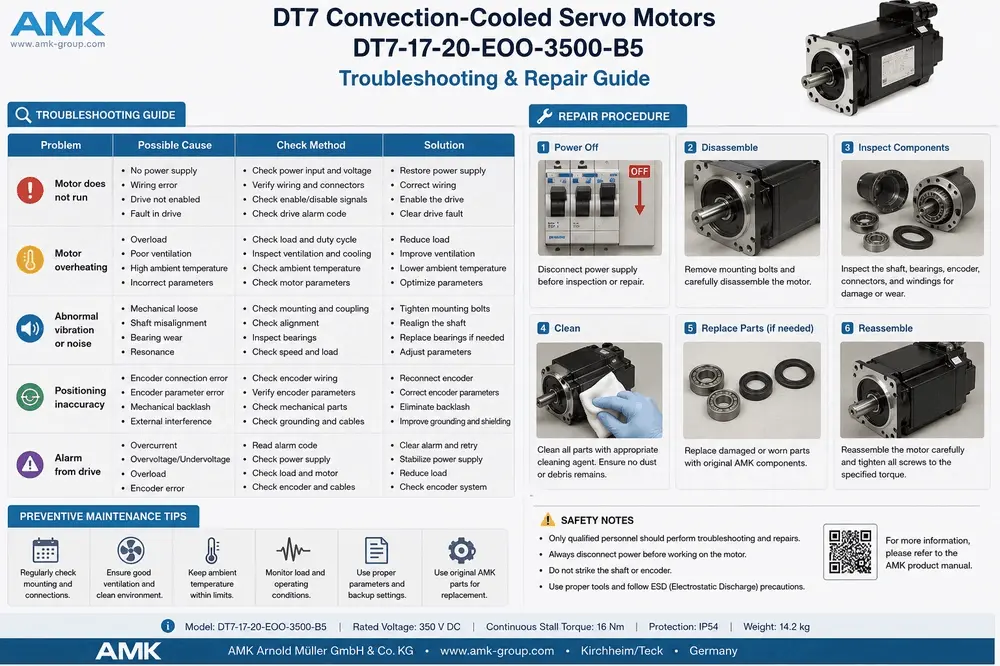
When an error occurs, the drive system usually registers a specific symptom. Understanding these symptoms allows you to pinpoint the root cause immediately. Below is the technical breakdown of the most common issues encountered with the AMK DT7 series, along with their precise diagnostic paths.
1. The Motor Does Not Run
When the motor remains completely stationary despite receiving commands, the issue is typically electrical or signal-related rather than a catastrophic mechanical failure.
● Possible Causes: Total loss of power supply, critical wiring errors, a disabled drive controller, or an uncleared fault active within the drive system.
● Check Method: Use a digital multimeter to verify the power input voltage at the terminal block. Ensure it reads the rated 350 V DC. Check the enable and disable digital signal lines to confirm the controller is actively commanding the motor to run. Review the active alarm logs on your drive interface.
● Solution: Restore the nominal power supply, correct any faulty wiring connections, activate the drive enable signals, and clear any existing drive fault codes.
2. Motor Overheating
The AMK DT7 relies entirely on natural convection for thermal management. Therefore, heat dissipation is highly dependent on its immediate environment.
● Possible Causes: Continuous mechanical overload, poor ambient ventilation, excessively high room temperatures, or corrupted motor parameters.
● Check Method: Check the active load cycles and duty periods against the motor’s 16 Nm continuous stall torque rating. Inspect the surrounding space for airflow obstructions and measure the ambient temperature.
● Solution: Reduce the mechanical load to match system limits, optimize surrounding ventilation channels, lower the room temperature, or recalibrate the motor parameters within the drive software.
3. Abnormal Vibration or Noise
Unusual acoustic feedback or physical vibrations indicate that the mechanical harmony of the system has been disrupted.
● Possible Causes: Loose structural mounting, shaft misalignment, worn internal bearings, or frequency resonance with the machine frame.
● Check Method: Inspect all mounting bolts and coupling elements. Check the shaft alignment using a dial indicator or laser alignment tool. Disconnect the load and rotate the shaft manually to listen for grinding noises in the bearings.
● Solution: Tighten all loose bolts to specified torques, realign the shaft, replace the bearings if they show signs of wear, and adjust the drive parameters to bypass resonant frequencies.
4. Positioning Inaccuracy
For direct-drive positioning and actuating applications, maintaining spatial accuracy is paramount.
● Possible Causes: Loose encoder connections, incorrect encoder parameters in the drive firmware, mechanical backlash, or severe external electromagnetic interference (EMI).
● Check Method: Verify encoder wiring integrity. Check if the feedback parameters match the 2048 P/Rev encoder specifications. Inspect mechanical couplings for backlash and evaluate the grounding of your cables.
● Solution: Reconnect or replace the encoder cable, correct the parameter settings in the controller, eliminate mechanical backlash, and upgrade the system grounding and shielding to block EMI.
Section 3: Step-by-Step Repair and Maintenance Procedure
If your troubleshooting path indicates that an internal component needs attention, you must execute a clean, methodical repair procedure. Standardized steps prevent secondary damage during the teardown.
Step 1: Power Isolation
Safety is the absolute priority. Disconnect the main power supply entirely before touching any electrical terminals or attempting mechanical disassembly. Lock out and tag out the power switches to ensure no one accidentally reactivates the system while you are working.
Step 2: Careful Disassembly
Remove the mounting bolts systematically. Carefully slide the motor away from its coupled load. When opening the motor housing, use specialized pullers to avoid applying sharp force to the shaft or the fragile encoder assembly at the rear.
Step 3: Component Inspection
Once opened, inspect the shaft for scoring, check the bearings for smooth rotation, examine the feedback encoder for debris, and look closely at the stator windings for signs of discoloration or electrical burning.
Step 4: Strict Cleaning
Clean all internal and external parts using an approved, residue-free industrial cleaning agent. Ensure that absolutely no dust, oil, or metallic debris remains inside the motor chambers before starting the reassembly process.
Step 5: Parts Replacement
When replacing worn elements like bearings or oil seals, never compromise on quality. Always use original AMK components to guarantee full compatibility and preserve the original IP54 protection rating. If the internal component failure extends to surrounding auxiliary equipment, sourcing matched parts from reliable technical vendors will ensure your systems return to peak performance.
Step 6: Precision Reassembly
Reassemble the housing components with care. Tighten all structural screws progressively in a cross-pattern to the exact torque values specified in the manual. This ensures even pressure distribution across the internal seals.
Section 4: Preventive Maintenance for Long-Term Reliability
The best way to handle motor errors is to prevent them from happening in the first place. Incorporating a strict preventive routine drastically cuts down unexpected operational failures.
Consistently monitor the ambient room temperature to ensure the convection cooling remains effective. Keep the motor exterior free of heavy dust accumulation, as dust acts as an insulator and traps heat inside the frame. Regularly test the drive parameters and maintain updated backups of your configuration files. Finally, whenever technicians open the drive cabinet or handle feedback cables, they must follow proper electrostatic discharge precautions to safeguard sensitive encoder electronics from invisible voltage spikes.
By adhering to this systematic approach, you can keep your AMK DT7 servo motors running smoothly, maximize your equipment life, and secure optimal manufacturing efficiency.