



How to Troubleshoot AMK DT3 Servo Motor Fault Codes?
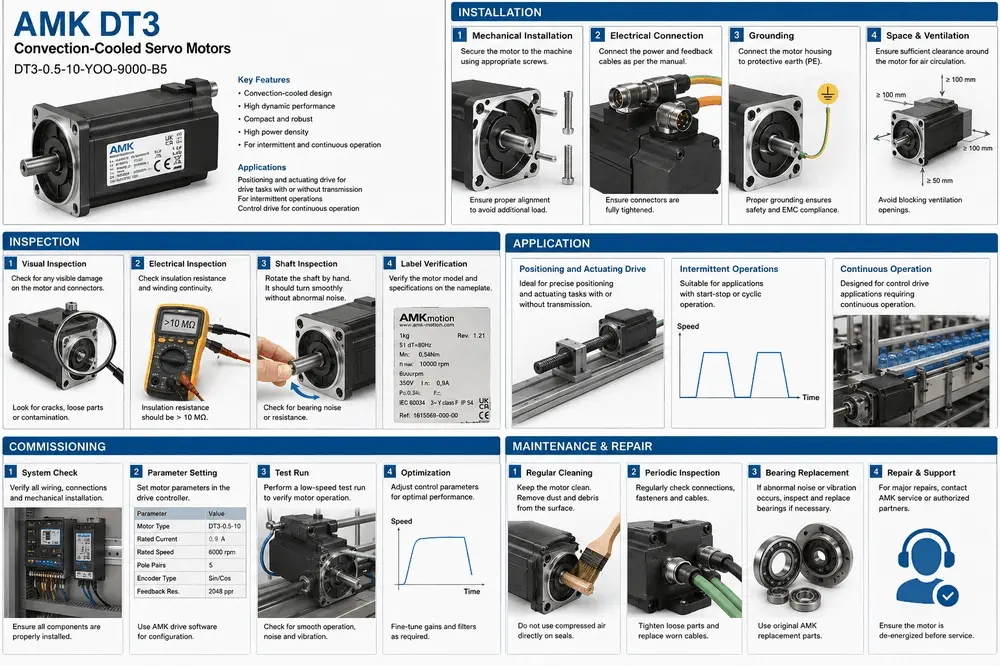
In highly automated industrial production lines, servo motors are the muscles behind precise movement. Among them, the AMK DT3 convection-cooled servo motor series—especially the high-performance AMK DT3-0.5-10-YOO-9000-B5—is widely trusted for its high power density, compact design, and reliability in both intermittent and continuous operations.
However, even the most robust system can encounter downtime due to electrical wear, mechanical overload, or feedback errors. When your drive controller flashes an error code, quick and accurate servo motor troubleshooting is essential to minimize costly production delays.
This comprehensive guide will walk you through decoding common AMK DT3 fault codes, conducting measurement checks, following the official diagnostic flow, and executing safe disassembly and repair.
1. Decoding AMK DT3 Fault Codes: What Do They Mean?
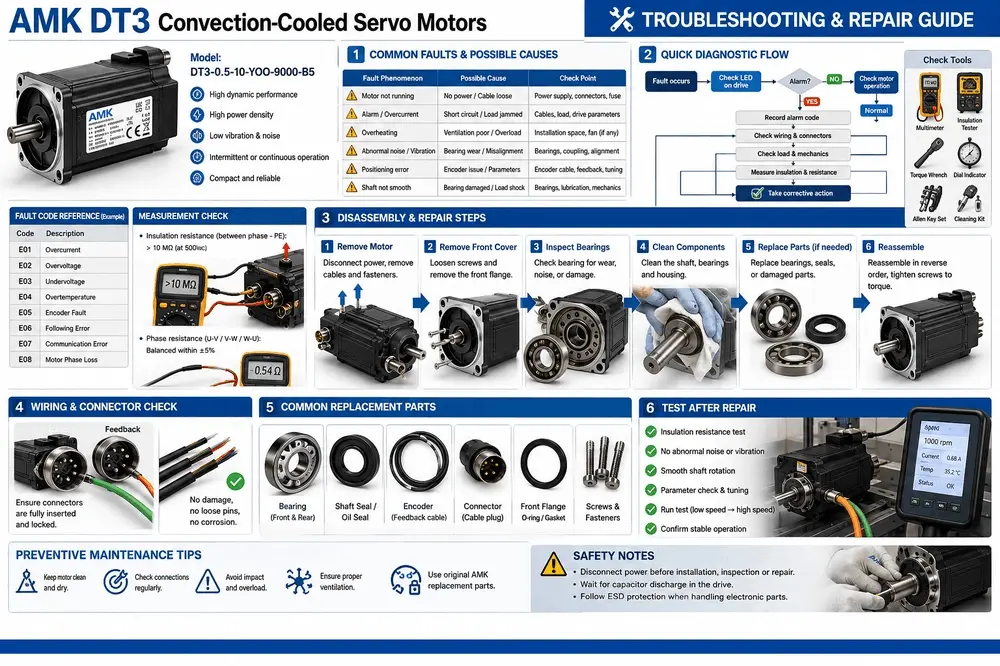
When an error occurs, the drive controller communicates the root cause via a specific fault code. Understanding these code definitions is your first step toward an effective AMK servo motor repair. Below are the most critical fault codes referenced for the AMK DT3 series:
● E01 – Overcurrent: This indicates that the current flow has exceeded the safe threshold. It is often caused by a short circuit in the motor windings, damaged power cables, or a sudden mechanical jam that forces the motor to draw excessive current.
● E02 – Overvoltage: This error pops up when the DC bus voltage spikes too high. It frequently happens during rapid deceleration if the regenerative braking energy cannot be dissipated properly, or if there is an issue with the power supply grid.
● E03 – Undervoltage: The opposite of E02, this means the incoming voltage is too low to sustain proper operation. Check for incoming power phase drops, blown fuses, or loose connections.
● E04 – Overtemperature: Convection-cooled motors rely on ambient air circulation. If the motor structure gets covered in dust, or if the space around the motor violates ventilation clearances, heat builds up rapidly, triggering E04.
● E05 – Encoder Fault: The encoder provides critical feedback to the drive. An E05 error means the feedback signal is lost, corrupted, or misaligned, usually due to a damaged feedback cable or internal encoder failure.
● E06 – Following Error: This occurs when the actual position of the motor deviates significantly from the commanded position. Mechanical blockages, incorrect parameter tuning, or overloading are the main culprits.
● E07 – Communication Error: A breakdown in the data link between the controller and the motor feedback system. Loose plugs or electromagnetic interference (EMI) often cause this.
E08 – Motor Phase Loss: One of the three power phases (U, V, W) is disconnected. This prevents the motor from generating a balanced magnetic field, leading to severe vibration or a complete failure to start.
2. The Quick Diagnostic Flow and Measurement Checks
Before tearing down the motor, you must perform systematic external checks using proper diagnostic tools like digital multimeters, insulation testers, torque wrenches, and dial indicators.
Step 1: Initial LED and Alarm Analysis
When a fault occurs, check the LED status on the drive controller. If the alarm is active, record the exact error code immediately.
Step 2: Essential Measurement Checks
Do not guess the issue when you can measure it. Two fundamental electrical checks can isolate most electrical faults:
1. Insulation Resistance Check: Use an insulation tester to measure the resistance between the motor phases and the protective earth (PE) housing. At 500V, the insulation resistance must be greater than 10 MΩ. If it is significantly lower, the winding insulation has degraded, risking a dangerous short circuit. For deeper insights into safe insulation testing practices, you can refer to Fluke's Industrial Electrical Testing Guidelines.
2. Phase Resistance Check: Measure the resistance between the phases (U-V, V-W, W-U) using a precise multimeter. The readings must be perfectly balanced within a ±5% tolerance. A reading of 0.54 Ω is typical for specific configurations, but any large imbalance confirms a damaged winding.
3. Disassembly and Repair Steps for AMK DT3 Motors
If the diagnostic flow points to an internal mechanical or electrical hardware failure, you will need to proceed with disassembly. Always follow these structured steps to avoid secondary damage to the precision components.
Step 1: Safe Motor Removal
Disconnect all power sources and wait for the drive capacitors to discharge completely. Label and remove the power and feedback cables. Loosen the fasteners securing the motor to the machine.
Step 2: Remove Front Cover and Inspect Bearings
Carefully loosen the housing screws and remove the front flange. Inspect the front and rear bearings. Spin the shaft by hand; it should turn smoothly without any abnormal noise, notchiness, or resistance. Check for bearing wear, misalignment, or signs of load shock.
Step 3: Clean and Replace Parts
If the bearings are worn or the shaft seal is leaking oil, replace them immediately. Clean the shaft, housing, and internal components to remove dust and debris. Crucial Rule: Always use original AMK motion replacement parts (such as genuine shaft seals, O-rings, and encoders) to guarantee compatibility and maintain IP ratings.
Step 4: Reassembly and Torque Tightening
Reassemble the components in the exact reverse order of disassembly. Use a torque wrench to tighten all screws to the manufacturer’s specified torque values. Ensure the front flange O-ring is perfectly seated to prevent fluid ingress.
4. Preventive Maintenance and Post-Repair Testing
To ensure your repaired AMK DT3 motor operates reliably and won't trigger another AMK DT3 fault codes alert, you must follow strict installation, maintenance, and testing protocols.
Essential Space & Ventilation Requirements
Because the DT3 is a convection-cooled servo motor, it does not use external fans. Air circulation is its only cooling mechanism. During reinstallation, ensure sufficient clearance:
● Maintain at least 100 mm of clearance on the top, bottom, and rear sides of the motor.
● Maintain at least 50 mm of clearance on the front side.
● Avoid blocking any ventilation openings or crowding the motor with other heat-generating equipment.
Post-Repair Testing Protocol
Before putting the motor back into full-scale production, perform a comprehensive post-repair test:
1. Insulation Verification: Re-verify that the phase-to-PE insulation is above 10 MΩ.
2. Smooth Shaft Rotation: Ensure there is no abnormal noise or vibration when running a low-speed test run.
3. Parameter Check & Tuning: Use the AMK drive software to verify parameter settings (e.g., matching the motor type, rated current of 0.9A, and rated speed of 6000 rpm). Fine-tune the control loops and filters if necessary.
4. Gradual Speed Run: Run a test from low speed to high speed (up to the maximum 10000 rpm specification if application permits) to confirm stable continuous operation.
Conclusion
Troubleshooting and repairing the AMK DT3 Convection-Cooled Servo Motor series requires a balance of systematic electrical testing and precise mechanical handling. By understanding the fault codes from E01 to E08, maintaining the strict 10 MΩ insulation threshold, and respecting the required 100 mm ventilation clearances, you can maximize the lifespan of your automation assets and keep your production lines running smoothly.
Do you have an AMK DT3 motor flashing an error code right now, or do you need genuine replacement parts to restore your system? Contact our expert technical support team today for professional diagnostic assistance, precise parameter configuration, and fast turnaround component sourcing!