



How to Optimize Tobacco Cutting Precision with AMK KW20 Servo Drive E769?
In the highly competitive tobacco manufacturing industry, margins are defined by milligrams and milliseconds. Tobacco cutting is a high-speed, high-precision process where even a microsecond of desynchronization can lead to uneven shreds, degraded product quality, and massive material waste. For procurement managers and plant operations directors, choosing the right automation component is not just a technical checklist item.
The AMK Servo Drive KW20 (Ordering Number: E769) has emerged as an industry benchmark for handling these high-stress environments. But how exactly does this specific hardware optimize tobacco cutting precision, and what makes it a smart investment for long-term operational efficiency? Let’s break down the technical integration, installation priorities, and maintenance protocols that guarantee flawless blade control.
The Crucial Link Between Blade Control and Servo Dynamics
Tobacco cutting machinery demands a rare combination of brute torque and microscopic accuracy. Blades rotate at extreme speeds, slicing tightly packed tobacco leaves into uniform strands. Any variance in motor speed directly translates to irregular product texture, which can ruin consumer experience and jam downstream cigarette rolling and packaging lines.
This is where the AMK KW20 E769 steps in. Engineered with advanced control loops, this servo drive delivers instantaneous current responses to counter the physical resistance changes encountered during cutting. By stabilizing the torque output, it ensures the blade maintains a constant, unyielding velocity.
Furthermore, integrating this unit within your tobacco cutting machinery automation framework minimizes mechanical backlash. The drive's firmware is optimized for synchronized multi-axis control, allowing the feeding conveyor and the cutting blade to operate in perfect harmony. When the feed rate fluctuates, the KW20 dynamic control loop adjusts the blade speed instantly, protecting both the product integrity and the machine's mechanical components.
Installation and Grounding: Setting the Foundation for Precision
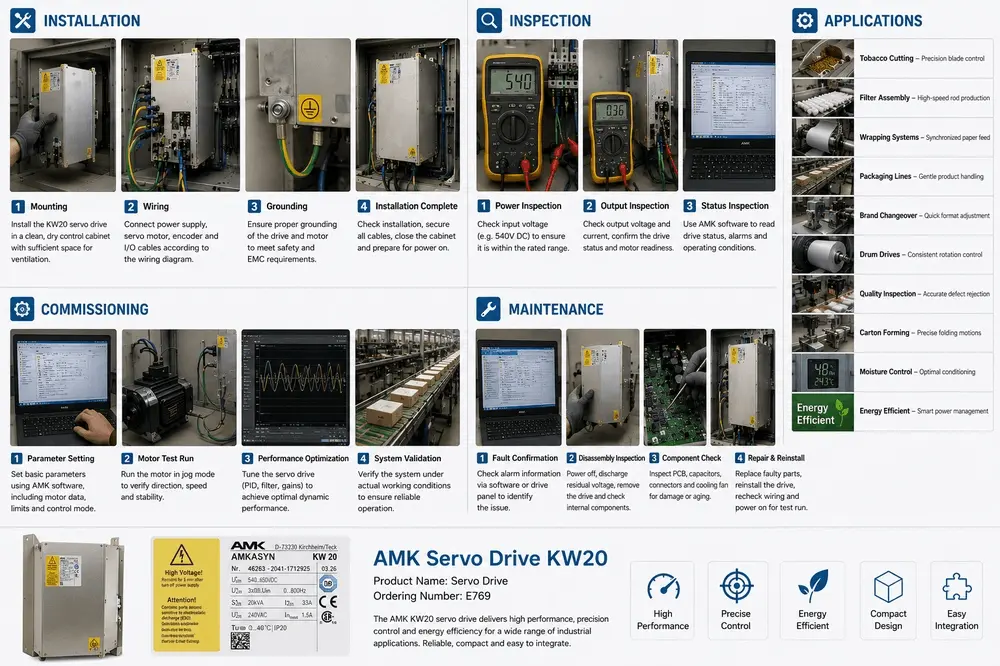
Achieving peak performance from a high-end servo drive requires meticulous field deployment. As outlined in the technical documentation, the installation of the KW20 servo drive follows a strict four-step process: mounting, wiring, grounding, and validation.
1. Thermal and Space Management
The KW20 servo drive packs high power density into a compact design. To prevent localized heat buildup, it must be mounted vertically inside a clean, dry control cabinet. Adequate ventilation clearance at the top and bottom is mandatory to facilitate natural or forced convection. For purchasing managers, ensuring your cabinet layouts match these physical dimensions prevents premature component aging.
2. Electrical Integration and Noise Suppression
High-speed cutting environments generate significant electromagnetic interference (EMI). To safeguard control signals, sensory encoder cables and primary power lines must be separated. Connecting the power supply, servo motor, encoder, and I/O cables strictly according to the official wiring diagram eliminates signal cross-talk, which is a frequent cause of intermittent micro-stoppages.
3. The Absolute Necessity of Grounding
In precision blade control, electrical noise can mimic speed commands, causing the blade to micro-shudder. Proper grounding is non-negotiable. The KW20 features dedicated grounding terminals designed to create a low-impedance path to the earth. Ensuring robust grounding across the drive, motor, and cabinet frame not only meets international safety compliance but also secures the signal integrity required for sub-millimeter cutting accuracy.
Commissioning for High-Speed Synchronization
Hardware installation is only half the battle; software calibration unlocks the drive's true potential. Using AMK’s proprietary software platform, engineers can set basic parameters tailored to tobacco processing specifications. This includes inputting exact motor data, setting operational speed limits, and configuring specialized control modes.
During the commissioning phase, a Motor Test Run in jog mode is highly recommended. This low-speed verification ensures that directional orientation and basic feedback loops are functioning correctly before the drive is subjected to full production loads.
The real differentiator in cutting quality lies in Performance Optimization. By finely tuning the Proportional-Integral-Derivative (PID) filters and gain settings, technicians can match the drive's responsiveness to the exact inertia of the heavy cutting blades. A well-tuned system exhibits zero overshoot and minimal settling time, meaning the machine hits its target operating speed almost instantly upon startup and recovers immediately from heavy impact loads.
Proactive Maintenance: Eradicating Unscheduled Downtime
From a procurement and financial perspective, the total cost of ownership (TCO) is heavily impacted by maintenance predictability. If a cutting line goes down, the financial losses stack up by the minute. Implementing a rigorous AMK Servo Drive KW20 maintenance protocol converts unexpected breakdowns into planned, manageable service windows.
When performance anomalies occur, technicians should leverage the software interface for fast Fault Confirmation. System logs read real-time drive status, alarms, and environmental conditions, immediately pointing to whether an issue is external (such as a cable loose or motor short) or internal.
Resolving Common Faults in Tobacco Production
To assist maintenance teams, the drive's diagnostics map out precise solutions for recurring industrial issues. Understanding these common faults allows procurement teams to keep the correct spare parts on hand:
Overcurrent and Overvoltage Challenges
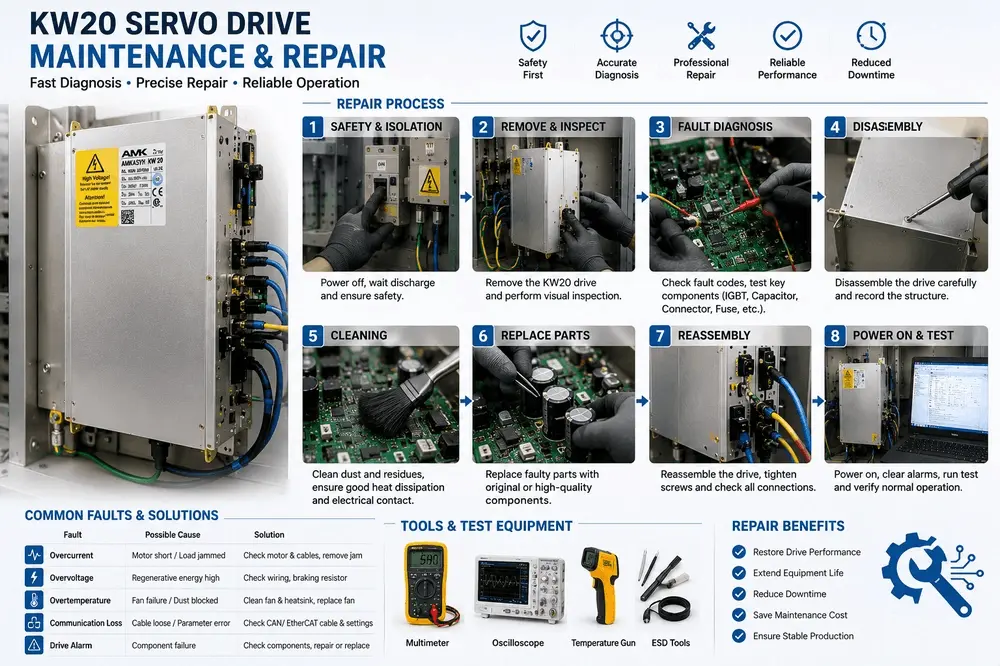
An Overcurrent alarm often points to a mechanical jam in the blade assembly or a short circuit within the motor cables. Clearing the jam and running a cable insulation check usually resolves the issue. Conversely, Overvoltage typically manifests during rapid deceleration of heavy cutting wheels. The regenerative energy generated by the spinning mass feeds back into the drive. Incorporating a correctly sized braking resistor dissipates this excess energy, keeping voltage thresholds within safe operational boundaries.
Environmental Stressors: Overtemperature and Communication Loss
Tobacco processing environments can be hot and dusty. If the drive triggers an Overtemperature fault, the culprit is almost always a clogged heatsink or a failing internal fan. Regular cleaning cycles completely mitigate this risk.
For Communication Loss, which halts multi-axis synchronization, the focus should shift to physical network health. Checking for loose CAN or EtherCAT cabling and verifying parameter node addresses eliminates network drops, ensuring continuous, uninterrupted communication between the main PLC and the servo drive. For a detailed breakdown of these steps, bookmark our comprehensive industrial servo drive troubleshooting
Should a component require deep inspection or replacement, following a standardized Repair Process is critical to protecting the asset:
● Safety & Isolation: Power down the main grid and wait for the internal high-voltage capacitors to fully discharge. Always verify zero voltage via a multimeter before touching internal terminals.
● Disassembly Inspection: Carefully extract the unit from the cabinet, ensuring all wire routing is documented or photographed for accurate reassembly.
● Component Check: Focus on inspecting the printed circuit boards (PCBs), power modules (IGBTs), DC-bus capacitors, and the internal cooling fan. Accumulations of tobacco dust inside the heatsink can block airflow, causing rapid overtemperature faults.
● Cleaning and Reassembly: Utilize specialized ESD tools to remove conductive dust and organic residues. Reinstall using original or equivalent high-quality parts, tightening all structural and electrical connections to specifications.
Strategic Value for Procurement Decision-Makers
Investing in the AMK KW20 E769 servo drive extends beyond acquiring premium hardware. It is a strategic move to future-proof production lines. The drive features intelligent smart power management, drastically reducing energy consumption compared to legacy systems. For enterprise buyers tracking carbon footprints and energy expenditures, these savings offer measurable support for corporate sustainability goals and directly reduce monthly utility overheads.
Furthermore, its compact envelope simplifies retrofitting, allowing older tobacco processing machinery to be upgraded without costly structural redesigns of existing electrical cabinets. With its high reliability, accurate diagnosis tools, and rapid repair processes, the KW20 minimizes downtime, maximizes line output, and ensures your cutting blades maintain flawless precision day after day.
Conclusion and Summary for Buyers
Optimizing tobacco cutting precision is a balancing act between robust electrical engineering and smart component procurement. The AMK KW20 Servo Drive E769 provides the exact speed stability and high-dynamic response required to keep blades sharp, cuts clean, and production lines moving. By enforcing correct installation procedures and adhering to structured maintenance checklists, factories can secure maximum asset longevity and exceptional product consistency.