



Where to Source Rexroth HMV01.1E Repair Spare Parts?
In modern automated manufacturing environments, unexpected downtime is the ultimate metric of operational failure. For factories utilizing Bosch Rexroth IndraDrive systems, the Rexroth HMV01.1E power supply module serves as the literal heartbeat of the production line. When a factory floor experiences a sudden fault in this critical unit, the procurement team faces immediate, high-stakes pressure. Sourcing the right parts quickly is no longer just a routine purchasing task; it becomes a critical exercise in risk mitigation and financial control.
For B2B procurement managers and MRO (Maintenance, Repair, and Operations) buyers, sourcing components for high-end German engineering presents a unique set of challenges. Long factory lead times, volatile global logistics, and the threat of counterfeit parts complicate the purchasing process. This comprehensive guide breaks down the technical anatomy of HMV01.1E wear-and-tear parts and outlines actionable sourcing strategies to balance your factory’s uptime with your operational budget.
One: Understanding the Failure Points: The Critical Spare Parts Checklist
Smart procurement begins with technical alignment. Rather than treating an industrial power supply as a single, unfixable black box, experienced buyers analyze the specific components that fail most frequently. By referencing technical documentation, such as the official Rexroth HMV01.1E manual, procurement teams can identify the exact sub-components driving equipment degradation.
According to industrial maintenance data, the components requiring the most frequent replacement within the HMV01.1E series include:
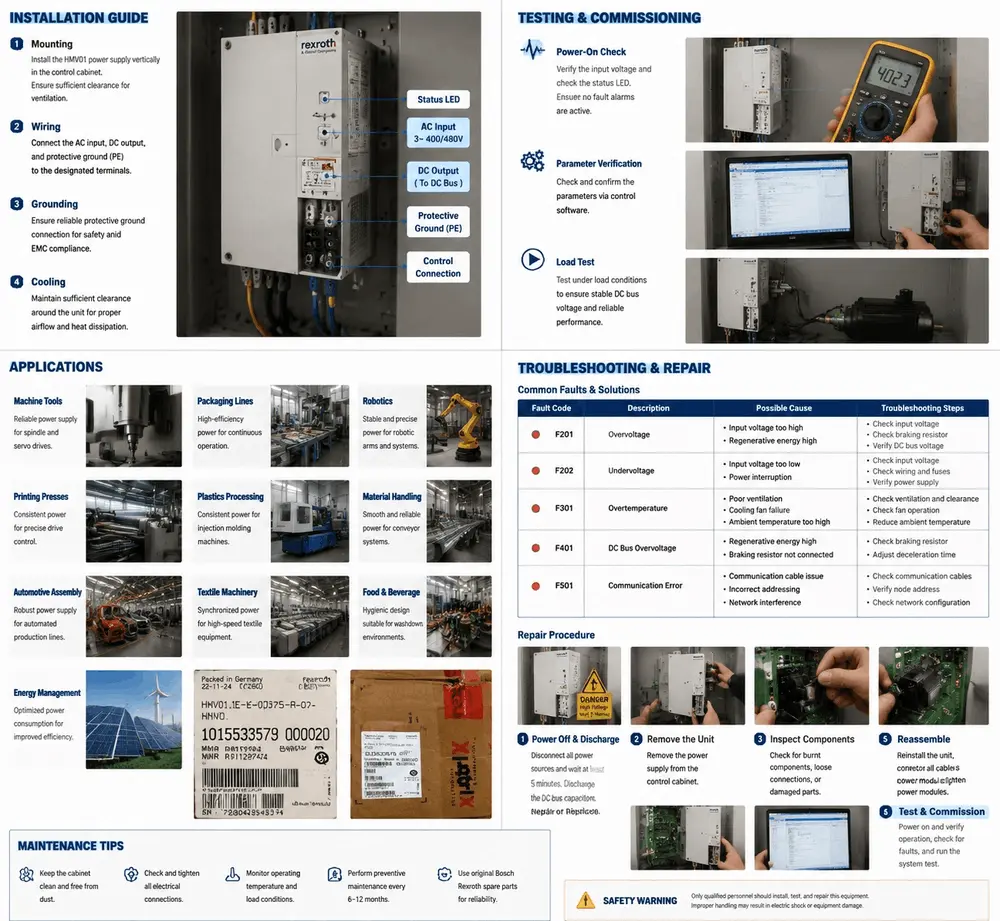
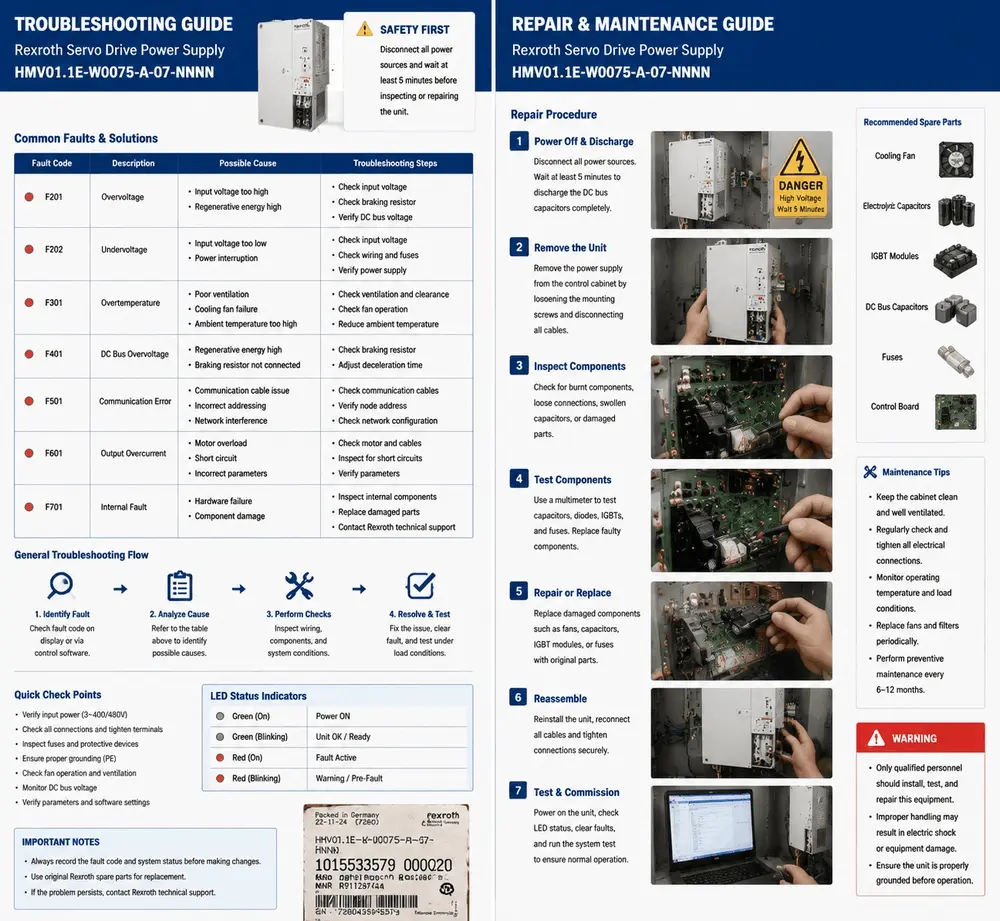
1. Cooling Fans: Operating in harsh, dusty, or high-temperature factory environments accelerates fan bearing failure. When a cooling fan degrades, it triggers overtemperature faults (such as the F301 error code), causing immediate system shutdowns to protect the internal circuitry.
2. Electrolytic & DC Bus Capacitors: Capacitors have a natural operational lifespan that degrades based on heat and voltage stress. Aging capacitors suffer from capacity loss or electrolyte leakage, which directly causes DC bus overvoltage or undervoltage faults.
3. IGBT Power Modules: Insulated-Gate Bipolar Transistors handle massive electrical switching loads. They are highly efficient but susceptible to thermal fatigue and electrical surges, making them a high-value, high-priority spare part.
4. Fuses and Varistors: These serve as the circuit's sacrificial frontline defense against external power spikes. Stocking these low-cost items prevents long delays for simple electrical resets.
5. Control Boards: The internal logic board processes all communication and drive commands. Damage to this board leads to fatal communication errors (like the F501 fault code) that halt the entire multi-axis drive system.
By proactively categorizing these components, purchasing departments can pivot from reactive, panic-driven buying to a structured, predictive sourcing model.
Two: Whole-Unit Replacement vs. Component Sourcing: The Financial Calculus
Every procurement manager faces a fundamental operational choice when an HMV01.1E unit fails: should you buy a complete, brand-new replacement module, or should you source individual components for an in-house rebuild? Navigating this choice requires a deep understanding of MRO supply chain management principles.
Scenario A: Whole-Unit Replacement (Capital Expenditure Focus)
● The Pros: This option offers the fastest path to recovery on the shop floor. Maintenance technicians simply swap the failed module with a new one, reducing immediate machine downtime to minutes. Furthermore, whole units purchased through authorized channels come backed by comprehensive manufacturer warranties.
● The Cons: The upfront financial expenditure is exceptionally high. Additionally, due to legacy component shortages and global logistics constraints, the factory lead times for a complete HMV01.1E power supply can span from several weeks to months, leaving your assembly lines vulnerable.
Scenario B: Strategic Component Sourcing (Operational Expense Focus)
● The Pros: The cost savings are monumental. Sourcing a replacement cooling fan, a set of high-grade capacitors, or a replacement fuse costs a small fraction of the price of an entire power supply unit. By holding a small inventory of these specific sub-components, internal engineering teams can perform preventive maintenance during scheduled weekend shutdowns.
● The Cons: This strategy demands internal technical expertise. Your facility must have qualified automation technicians capable of safely discharging the DC bus (which requires at least 5 minutes after power-off, as noted in the safety warnings) and performing precise component level soldering.
The Optimal Hybrid Strategy: For bottlenecks or high-priority production lines, procurement should secure at least one complete HMV01.1E unit as a critical emergency backup. For secondary production lines or standardized multi-axis setups, the most cost-effective path is to maintain a rolling safety stock of OEM-grade cooling fans, fuses, and capacitors. This balanced approach protects production continuity while keeping warehouse capital allocation lean.
Three: Evaluating Vendor Channels: Where to Safely Source Spares
Once your bill of materials is finalized, finding a trustworthy vendor is paramount. The industrial marketplace is filled with surplus stock, refurbished units, and unauthorized components. To secure authentic parts that meet rigorous German manufacturing standards, buyers should diversify across three main vendor tiers:
1. Authorized OEM Distributors
Purchasing directly from the original equipment manufacturer or their certified regional partners guarantees 100% component authenticity, access to the latest product revisions, and official warranty support. However, procurement teams must be prepared for rigid pricing models and potentially sluggish response times when dealing with urgent, line-down emergencies.
2. Independent Industrial Automation Stocking Distributors
Independent distributors specialize in high-velocity sourcing and often maintain extensive physical inventories of hard-to-find, long lead-time, or discontinued legacy parts. When working with these partners for your industrial automation spare parts procurement, vet them based on their testing capabilities, warranty periods, and ability to match exact manufacturer part numbers (MNR numbers, such as R911297424). A reliable independent partner can often ship an HMV01.1E component within 24 to 48 hours, effectively solving acute lead-time crises.
3. Authorized Electronic Component Brokers
For component-level assets like cooling fans, standard fuses, and industrial-grade capacitors, going through specialized electronic component distributors (such as Mouser, Digi-Key, or Arrow Electronics) is highly efficient. These platforms provide transparent pricing, immediate stock availability, and verified manufacturer traceability, making them ideal for scaling up your preventive maintenance inventory.
Conclusion: Future-Proofing Your Automation Sourcing
Successful industrial procurement is measured by a buyer's ability to anticipate failures before they manifest as costly line stoppages. By mastering the component lifecycle of the Rexroth HMV01.1E series, recognizing high-risk failure points, and cultivating a diverse network of authorized and independent supply partners, you can successfully shield your facility from the catastrophic financial impacts of unexpected machine downtime.